
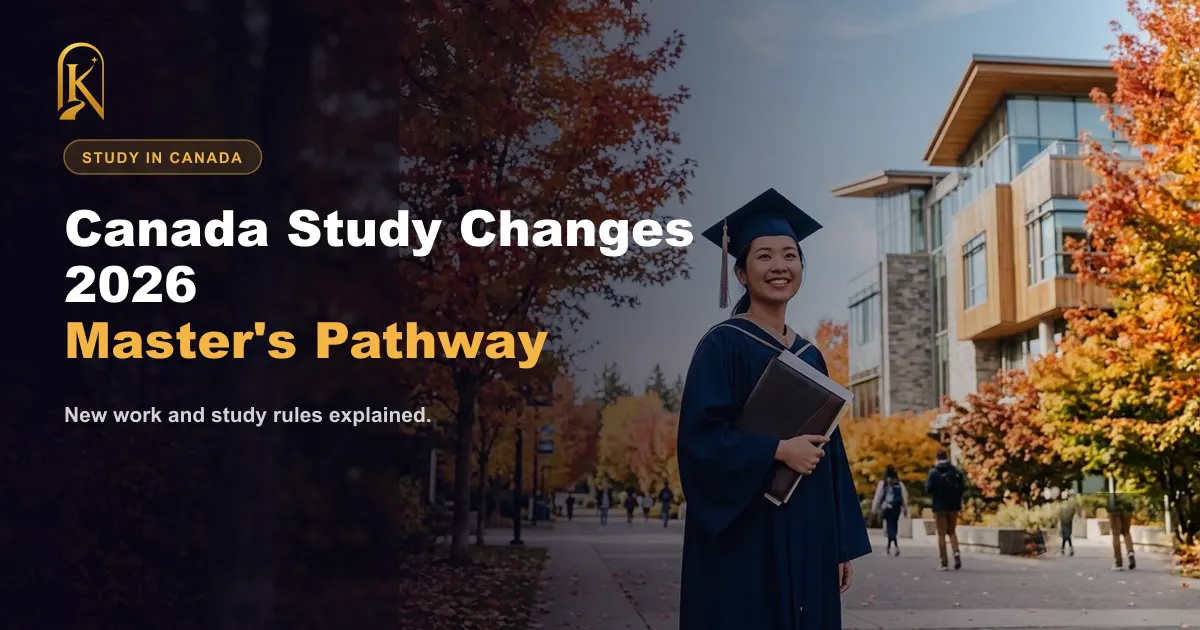








Canada made two 2026 changes that matter for international students: from 1 April 2026, eligible post-secondary students no longer need a separate co-op/intern work permit for a required placement; and from 1 January 2026, applicants to degree-granting master's or doctoral programmes at public institutions are exempt from the Provincial/Territorial Attestation Letter (PAL/TAL). Separately, the three-year PGWP for qualifying master's graduates is not new — it has applied since 15 February 2024. Other study-permit and PGWP conditions still apply.
Sources: IRCC — Simplifying the co-op work permit requirement ; IRCC — About the post-graduation work permit ; IRCC — Study permit PAL/TAL documents
Sources: IRCC — Simplifying the co-op work permit requirement ; IRCC — Study permit PAL/TAL documents ; IRCC — 2026 provincial/territorial allocations under the international student cap
What Changed in 2026
Two rules genuinely changed in 2026. The master's PGWP row below is included for context only — it is dated 15 Feb 2024, not 2026, and should never be read as a new benefit this year.
| Change | Effective date | Who benefits | Caveats |
|---|---|---|---|
| Separate co-op/internship work permit removed | 1 April 2026 | Students whose programme requires a co-op/internship/practicum placement | Placement must be required, DLI-approved, student full-time & eligible, and 50% or less of the programme |
| 3-year PGWP for qualifying master's programmes under two years | 15 Feb 2024 (still applies in 2026 — NOT a 2026 rule) | Graduates of eligible Canadian master's degree programmes of 8 months or longer | Must meet all other PGWP requirements; passport validity can limit permit length |
| PAL/TAL exemption for master's/doctoral at public DLIs | 1 January 2026 | Applicants to degree-granting master's/doctoral programmes at public DLIs | Private institutions & non-degree grad programmes NOT covered; Quebec applicants generally still need a CAQ |
Sources: IRCC — Work in a student work placement ; IRCC — About the post-graduation work permit ; IRCC — Study permit PAL/TAL documents
Don't mix up the dates
Only the co-op permit removal (1 Apr 2026) and the PAL/TAL exemption (1 Jan 2026) are new this year. The master's PGWP rule has been in force since 15 February 2024 — it is context, not a 2026 announcement.
Source: IRCC — About the post-graduation work permit
Co-op Permit No Longer Required (from 1 Apr 2026)
Eligible post-secondary international students no longer need a separate co-op work permit for a required placement (co-op/internship/practicum/mentorship). A valid study permit can cover it when all conditions are met: full-time at a Canadian DLI; enrolled in a post-secondary academic/vocational/professional programme; valid study permit (or applied to extend before expiry); study-permit conditions allowing on-campus work; a DLI letter confirming the placement is required; and the placement is 50% or less of the whole programme.
What it does NOT mean
- Not unrestricted permission to work — it applies to a programme-required placement, not an unrelated job.
- No separate weekly hour limit for the required placement, but it still cannot exceed 50% of the programme.
- The employer must be accepted by the school's placement programme.
- Ordinary off-campus rules are unchanged (generally up to 24 hours/week off campus during sessions, full-time during scheduled breaks, subject to conditions).
- Pending co-op work-permit applicants need not act — IRCC may withdraw those applications.
- Secondary-school students still need a co-op work permit. This change is for eligible post-secondary students.
Sources: IRCC — Work in a student work placement ; IRCC — Simplifying the co-op work permit requirement ; IRCC — Work off campus
The Master's PGWP Rule (Existing Since 2024 — Context)
A graduate may apply for a 3-year PGWP even if the master's programme lasted under two years, provided: the programme is 8 months or longer (or 900 hours or more in Quebec); completed at a PGWP-eligible DLI; and the applicant meets other PGWP requirements. This applies to qualifying master's degreeprogrammes — not certificate or diploma programmes. It is accurate to call it a potential “flat 3-year PGWP” for qualifying master's grads — it is not accurate to call it a new 1 Jan 2026 rule.
PGWP conditions that still apply
- Completed a programme at a PGWP-eligible DLI.
- Programme is 8 months or longer (or 900 hours or more in Quebec).
- Full-time each semester (part-time allowed only in the final semester).
- Apply within 180 days of completion confirmation.
- Held a valid study permit at some point in the 180 days after completing.
- The PGWP can be shorter if the passport expires earlier.
- Language:degree grads (bachelor's/master's/doctoral) must prove English/French at CLB/NCLC 7 in all four skills (since 1 Nov 2024).
- Field of study: degree grads (bachelor's/master's/doctoral) are exempt from the field-of-study requirement entirely — there is no field-of-study list for degree graduates. That list applies only to certain non-degree programmes, and IRCC has frozen the non-degree list for 2026.
Sources: IRCC — About the post-graduation work permit ; IRCC — PGWP: Who can apply ; IRCC — PGWP: Field of study requirement
PAL/TAL Exemption + the Study-Permit Cap (from 1 Jan 2026)
From 1 Jan 2026, applicants do not need a PAL/TAL when applying for a study permit for a degree-granting master's or doctoral programme at a publicDLI. This is narrower than “all master's exempt”: it must be degree-granting, master's/doctoral level, and at a public DLI. Private colleges and non-degree graduate certificates are not automatically exempt.
IRCC's 2026 allocation notice sets a target of up to 180,000 study permits for applicants who do need a PAL/TAL. The exemption removes the PAL/TAL hurdle for qualifying public-university graduate applicants — it does not guarantee approval (admission, funds, identity and admissibility are still assessed; a study permit is still required for most programmes longer than 6 months).
Quebec caveat
Students planning to study in Quebec generally need a Quebec Acceptance Certificate (CAQ), which serves as (and includes) their PAL. Almost all Quebec-bound international students need a CAQ — even those exempt from the federal PAL requirement.
Sources: IRCC — Study permit PAL/TAL documents ; IRCC — 2026 provincial/territorial allocations under the international student cap
Key Dates Timeline
| Date | What happened |
|---|---|
| 15 Feb 2024 | 3-year PGWP rule for qualifying master's programmes (8 months or longer) began (not a 2026 change) |
| 1 Nov 2024 | New PGWP language requirements began for most applicants, including degree grads |
| 1 Jan 2026 | Master's/doctoral applicants at public DLIs exempt from PAL/TAL |
| 1 Apr 2026 | Eligible post-secondary students stop needing a separate co-op work permit for qualifying required placements |
| Throughout 2026 | PGWP eligible field-of-study list frozen; degree grads remain exempt from the field-of-study requirement |
Sources: IRCC — About the post-graduation work permit ; IRCC — Work in a student work placement ; IRCC — Study permit PAL/TAL documents ; IRCC — PGWP: Field of study requirement
Study-to-Work Pathway (for a SG Poly/Degree Grad)
- Apply to a qualifying Canadian master's at a public DLI → obtain a study permit (from 1 Jan 2026, a qualifying public-university master's application needs no PAL/TAL).
- Study full-time, follow study-permit conditions.
- Complete any compulsory internship/co-op/practicum without a separate co-op work permit (from 1 Apr 2026, if conditions are met).
- Graduate from a PGWP-eligible programme.
- Apply for the PGWP within 180 days.
- If eligible, get up to 3 years of Canadian work experience.
The PGWP is not permanent residence and does not guarantee it.
Source: IRCC — PGWP: Who can apply
What This Means for Families
For a Singapore poly or degree graduate eyeing a Canadian master's, 2026 removes two friction points — no separate co-op permit for required placements, and no PAL/TAL for public-university graduate applications — while the established 3-year PGWP makes the study-to-work runway attractive.
Two friction points are gone in 2026 — but the 3-year PGWP itself is a 2024 rule, not a 2026 one.
Sources: IRCC — Simplifying the co-op work permit requirement ; IRCC — Study permit PAL/TAL documents ; IRCC — About the post-graduation work permit
Frequently Asked Questions
Do Singapore students need a separate co-op work permit in 2026?
Not if they are an eligible post-secondary student whose required placement meets IRCC conditions: study-permit work conditions, a DLI confirmation letter, full-time status, and a placement that is 50% or less of the programme.
Is the 3-year master's PGWP a new January 2026 benefit?
No. The special master's rule dates to 15 February 2024. It is still relevant in 2026, but it was not introduced in 2026.
Can an 8-month master's lead to a 3-year PGWP?
It may, if it is a qualifying master's degree programme of at least 8 months at a PGWP-eligible DLI and all other requirements are met. It does not apply to an 8-month certificate or diploma.
Do master's applicants still need a PAL/TAL?
From 1 January 2026, no — for a degree-granting master's or doctoral programme at a public DLI. Private colleges and non-degree graduate programmes are not automatically exempt, and Quebec-bound applicants generally still need a CAQ.
Does the PGWP lead to permanent residence?
No. The PGWP provides Canadian work experience but is not permanent residence and does not guarantee it. Any later immigration application is assessed under the rules in force at that time.
Related Resources
New Zealand Post-Study Work Visa 2026
See how New Zealand's post-study work visa rules compare with Canada's PGWP pathway.
Australia's 2026 Student Visa Cap
Compare Australia's 295,000 student visa cap with Canada's PAL/TAL allocation system.
The bottom line
For a Singapore poly or degree graduate eyeing a Canadian master's, 2026 removes two friction points — no separate co-op permit for required placements, and no PAL/TAL for public-university graduate applications — while the established 3-year PGWP makes the study-to-work runway attractive. Check the current canada.ca pages before applying, as immigration rules change.
Note on completeness:All figures and dates are confirmed against IRCC canada.ca pages. The 3-year master's PGWP is deliberately framed as a 2024 rule, not a 2026 one. Permanent-residence outcomes are not covered here (they are assessed separately). Immigration rules change — verify on canada.ca before acting.
Sources
- 1.IRCC — Simplifying the co-op work permit requirement. canada.ca
- 2.IRCC — Work in a student work placement. canada.ca
- 3.IRCC — About the post-graduation work permit. canada.ca
- 4.IRCC — PGWP: Who can apply. canada.ca
- 5.IRCC — PGWP: Field of study requirement. canada.ca
- 6.IRCC — Work off campus. canada.ca
- 7.IRCC — Study permit PAL/TAL documents. canada.ca
- 8.IRCC — 2026 provincial/territorial allocations under the international student cap. canada.ca
Cite this page:SGSchoolKaki Education Team, “Canada Study Changes 2026 Singapore: Master's Pathway,” SGSchoolKaki, 18 Sept 2026, https://sgschoolkaki.com/blog/canada-international-student-work-rules-2026.