
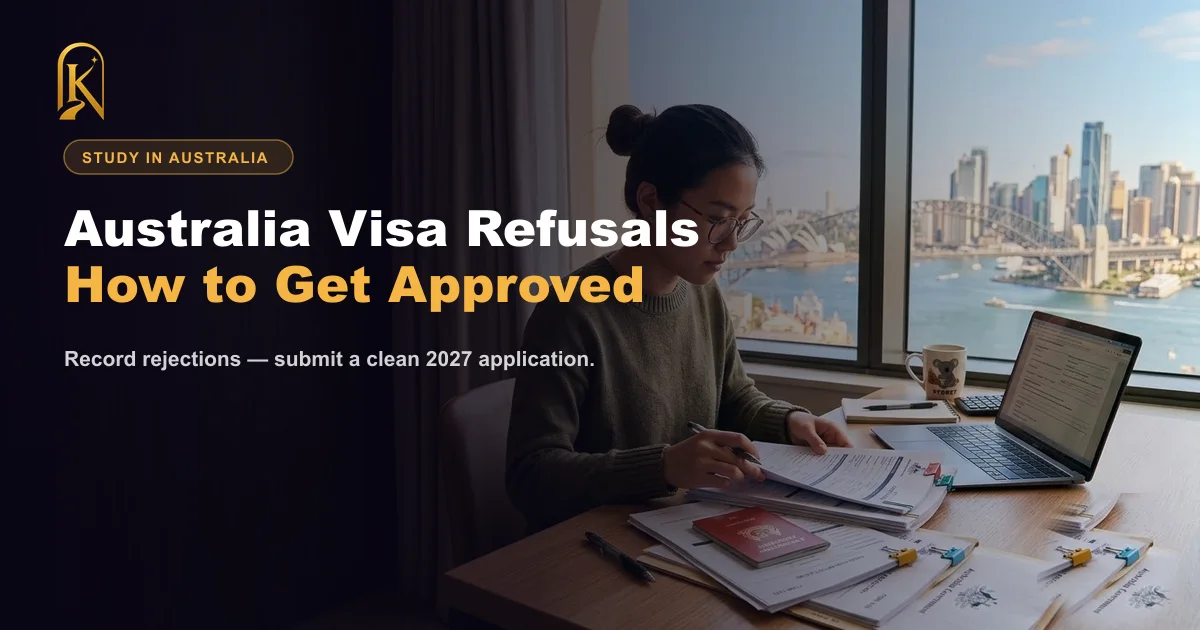



For 2027, getting an offer from an Australian university will often be the easy part; clearing the Subclass 500 visa is now the real hurdle for international students, including those from Singapore. In early 2026, Australia's Department of Home Affairs (DHA) data showed offshore higher-education student-visa refusal rates at their highest levels in roughly two decades, with around one in three applicants refused in February and grant rates falling further in March.
This article explains the refusal wave, the Genuine Student (GS) requirement, processing times, and how Singaporean students can structure a clean, low-risk file for the 2027 intake.
Sources: ICEF Monitor (Apr 2026) ; The PIE News
How Bad Is Australia's 2026 Refusal Wave?
ICEF Monitor, reporting Home Affairs data, states that offshore higher-education student-visa refusals (Subclass 500) reached about 32.5% in February 2026 — described as the most significant refusal level in 21 years of tracking, with roughly one in three applicants rejected. That equals a grant rate of about 67.5% in February, compared with typical approval rates of around 85-90% in earlier years.
Source: ICEF Monitor (Apr 2026)
Sector reporting indicates the offshore higher-education grant rate fell further through early 2026, continuing the downward trend. The PIE News reports that offshore higher-education grant rates had fallen from around 86-87% to 78%. Sector reports consistently describe 2026 as Australia's toughest student-visa environment in about two decades, driven by integrity checks and Genuine Student-related refusals rather than a fall in university offers.
Source: The PIE News
Refusal risk varies sharply by source country (Feb-Q1 2026, offshore higher education). These figures come from sector analyses of DHA data and should be read as indicative, not official per-country statistics:
| Country / Region | Reported refusal rate (Feb-Q1 2026, offshore HE) |
|---|---|
| Nepal | ~65% (Feb 2026) |
| Bangladesh | ~51% (Feb 2026) |
| India | ~40% (Feb 2026) |
| Sri Lanka | ~38% (Feb 2026) |
| Bhutan | ~36% (Feb 2026) |
| Pakistan | 30% or more (Q1 2026) |
| China | ~3.5% (among the lowest globally) |
Source: ICEF Monitor (Apr 2026)
Singapore-specific note:as at 12 August 2026, publicly accessible sources summarising DHA data do not break out refusal or grant rates specifically for Singaporean applicants, though Singapore is generally grouped with other “low-risk” (Assessment Level 1) countries. Note on completeness: the country-level figures above exclude Singapore because verified, disaggregated Singapore data was not located.
From GTE to Genuine Student (GS): What Changed?
Australia replaced the previous “Genuine Temporary Entrant” (GTE) statement with the Genuine Student (GS) requirement, implemented through structured questions in ImmiAccount. GS is assessed via four targeted 150-word questions covering your circumstances, reasons for choosing the course and provider, how it fits your future plans, and your education history. The GS requirement has become the leading driver of Australian student-visa refusals since its introduction. Case officers cross-check your answers against the rest of your file — offers, transcripts, work history, financial evidence and any previous visa or study history — to judge whether study is genuinely the primary purpose of your application.
Source: Dept of Home Affairs — Genuine Student requirement
What assessors look for under GS
- Coherent study plan — a clear link between your past studies, your chosen Australian course, and a realistic career pathway, with specific (non-generic) reasons for that provider and qualification.
- Credible personal circumstances — your financial situation, family ties, job prospects in Singapore and the region, and any prior study or visa history.
- Consistency across the file — GS answers are checked against documents; discrepancies in timelines, unexplained gaps or contradictions raise risk.
- Genuine access to funds— weak proof of funds, or accounts that look “arranged” purely for the visa, can lead to refusal even if balances meet minimums.
Common Subclass 500 Refusal Reasons in 2026
- Weak or generic GS answers — copied or templated statements, vague motivations, and course choices that don't match the applicant's background.
- Insufficient or non-credible financial evidence — funds not clearly documented, recent, or genuinely accessible, even if headline amounts look adequate.
- Course choice misaligned with history — an abrupt jump from unrelated prior study or work into a new field without a convincing explanation.
- Missing or inconsistent documents — incomplete files, outdated documents, or inconsistent information across forms, statements and bank evidence.
- High-risk profiles without extra care — applicants from high-refusal regions who submit generic GS statements and minimal financial proof.
Financial Capacity: The AUD 29,710 Rule and Beyond
The Department of Home Affairs uses set living-cost figures when assessing whether a student has enough funds for the first 12 months of stay, on top of tuition and travel. The living-cost benchmark for a primary student-visa applicant is AUD 29,710 per year, with additional amounts for accompanying dependants. For a single applicant, the working minimum Home Affairs expects to see is first-year tuition plus travel plus the AUD 29,710 living-cost amount, all supported by acceptable evidence.
Source: Dept of Home Affairs — Student visa Subclass 500
Financial evidence generally accepted
- Savings and deposits— bank statements showing funds held (in your name or a close family member's) for at least several months, or term-deposit certificates.
- Education loans — formal loan letters from recognised financial institutions or government loan schemes.
- Sponsor income and assets — salary slips, tax returns or employer letters, supported by bank statements showing regular credits.
- Scholarships and official funding — government or institutional letters stating tuition coverage and any living-cost stipends.
Funds must be “visible, documented and available”, not simply promised verbally; unclear or last-minute transfers often trigger additional questioning or refusal.
How Long Will a 2027 Subclass 500 Take to Process?
Home Affairs processing-time pages and independent analyses agree student-visa decision times shortened in 2026 but remain variable. The Department's visa-processing-times page lists Student visas lodged outside Australia with a standard guide of around 17 days, subject to prioritisation. Sector guides report a typical range of 4-8 weeks, with the majority finalised within 8 weeks. For Assessment Level 1 countries — which include Singapore — one 2026 guide reports a median of around 22 days in Q1 2026.
Source: Dept of Home Affairs — Global visa processing times
Note on completeness: while Singapore is listed as an Assessment Level 1 country, exact student-visa refusal or grant percentages for Singapore were not found in the current sources.
Getting the Offer vs Getting the Visa
In 2026-2027, an unconditional offer from an Australian university is no longer a strong guarantee of a visa, especially for offshore applicants. Students who met admission, English-language and financial thresholds have still been refused on GS or integrity grounds. For Singaporean students, applying early, choosing realistic courses, and preparing a complete, well-explained visa file matters more than chasing multiple offers or assuming a prestigious admit guarantees approval.
Source: The PIE News
Students who met admission, English-language and financial thresholds have still been refused on GS or integrity grounds — the offer is no longer the decisive step, the visa is.
Checklist: How Singaporean Students Can Apply So They Get Approved
- 1Build a coherent study and career story. Choose a course that fits your academic background or documented career goals; explain any change of field with concrete reasons. Reference specific modules, accreditation or links to Singapore's job market in your GS answers.
- 2Answer the GS questions properly. Treat the four GS questions as mini-essays (up to 150 words each), written in your own words and tailored to your circumstances. Avoid templates; ensure dates, qualifications and work history match your transcripts, CV and forms.
- 3Prepare robust financial evidence. Budget realistically: first-year tuition plus travel plus at least AUD 29,710 in living costs for a single applicant. Provide clear bank statements, fixed-deposit or loan documents and, if sponsored, salary slips and tax records showing genuine, ongoing access to funds.
- 4Submit a complete, consistent file. Check that your offer letter, Confirmation of Enrolment (CoE), passport, transcripts, language-test scores and financial documents are up-to-date and uploaded under the correct ImmiAccount categories. Avoid last-minute course/provider changes after lodgement.
- 5Time your application strategically. Using current processing-time data (median around 3-6 weeks for many low-risk applicants), lodge at least two to three months before your intended start date to allow for any requests for further information.
- 6Treat integrity as non-negotiable. Ensure all information is accurate; discrepancies or misrepresentation can lead to refusal and longer-term issues. Avoid "arranged" bank balances or inconsistent sponsor stories.
Common Refusal Reasons vs How to Avoid Them
| Common refusal reason (2026) | What it looks like | How to avoid it |
|---|---|---|
| Weak or generic GS answers | Short, template-like responses; no link between course and prior study/career | Write detailed, personalised answers; show why this specific course and provider are essential and realistic |
| Insufficient / non-credible finances | Large deposits just before lodgement; missing sponsor income docs; unclear fund ownership | Show stable balances over several months; include sponsor payslips and tax records; label each document clearly |
| Course misaligned with background | Sudden switch from unrelated study/work with no explanation | Choose a course that matches your record, or clearly justify the change (bridging modules, industry demand) |
| Incomplete / inconsistent documents | Missing transcripts, expired language scores, mismatched dates | Use a document checklist; cross-check all dates; upload legible PDFs under correct categories; respond promptly to DHA requests |
| High-risk profile, no compensating evidence | Generic GS + minimal financial proof | Even from low-risk Singapore, submit a fully documented GS and financial case; address any complexity (gaps, prior refusals) directly |
Frequently Asked Questions
Are Singaporean students affected by Australia's 2026 refusal wave?
Publicly reported DHA-based data show a sharp rise in offshore higher-education student-visa refusals overall, but do not break out specific refusal or grant rates for Singaporean applicants. Singapore is commonly grouped among Assessment Level 1 ("low-risk") countries for processing-time purposes — one 2026 guide reports a median of about 22 days — yet exact Singapore-only refusal percentages are not published in the sources used here.
Source: ICEF Monitor (Apr 2026)
What is the Genuine Student (GS) requirement in simple terms?
The GS requirement is a set of structured questions in the online application that ask whether study is genuinely the main purpose of your visa, replacing the older GTE statement. You explain your circumstances, why this specific course and provider make sense, how they fit your future plans, and how your education history supports your case — all cross-checked against your documents.
How much money do I need to show for an Australian student visa in 2026?
Home Affairs sets the living-cost benchmark for a primary student-visa applicant at AUD 29,710 per year, on top of first-year tuition and travel costs, with more required for any dependants. The funds must be genuinely documented and accessible, not just shown as a last-minute balance.
If my child already has a university offer, is the visa a formality?
No. In 2026-2027 an offer no longer guarantees a visa. Applicants who met admission, English and financial thresholds have still been refused on Genuine Student or integrity grounds. A complete, consistent, well-explained visa file is now as important as the offer itself.
Source: The PIE News
How early should a Singaporean student lodge the Subclass 500 for a 2027 intake?
Using current processing-time data (a median of roughly 3-6 weeks for many low-risk applicants, and around 22 days for Assessment Level 1 countries in Q1 2026), lodge at least two to three months before the intended start date to absorb any request for further information.
Related Resources

Australia Student Visa Cap 2026 Guide
How the 2026 National Planning Level, MD115 and provider allocations shape visa timing — separate from the refusal-rate issue covered here.
US F-1 Visa Four-Year Rule
How the new US fixed admission period compares for Singaporean students weighing study destinations.
The bottom line
Australia's 2026 refusal wave has changed the maths of studying Down Under: the visa, not the offer, is now the decisive step. Singaporean students remain in a comparatively favourable position as a low-risk cohort, but that advantage only holds when the Genuine Student answers are specific, the finances are genuinely documented, and the file is complete and consistent from the day it is lodged.
Note on completeness: headline refusal and grant rates are drawn from sector analyses of Home Affairs data; per-country figures are indicative rather than official. No Singapore-specific refusal or grant rate was available at the time of writing. Living-cost and processing-time figures reflect Home Affairs settings current in mid-2026 and should be re-checked on the official site before lodging.
Sources
- 1.Department of Home Affairs — Genuine Student requirement. immi.homeaffairs.gov.au
- 2.Department of Home Affairs — Subclass 500 Student visa (funds/eligibility). immi.homeaffairs.gov.au
- 3.Department of Home Affairs — Global visa processing times. immi.homeaffairs.gov.au
- 4.ICEF Monitor (April 2026). monitor.icef.com
- 5.The PIE News — Australia’s visa quality correction. thepienews.com
- 6.VnExpress International (DHA data, 2026). e.vnexpress.net
Cite this page: SGSchoolKaki Education Team, “Australia Student Visa Refusals 2026 Singapore: Get Approved,” SGSchoolKaki, 25 Sept 2026, https://sgschoolkaki.com/blog/australia-student-visa-rejection-2026.