


Updated 17 Sep 2026 — what changes for PR families in 2027. From the 2027 P1 Registration Exercise, reserved Phase 2C places rise from 40 to 60 at most schools, and 12 schools split Phase 2C into two distance tracks. For PR families the ordering is unchanged but worth stating precisely: MOE will admit all Singapore Citizen applicants across both tracks first, before any PR applicant is considered for the remaining vacancies. → Full Two-Track Scheme guide
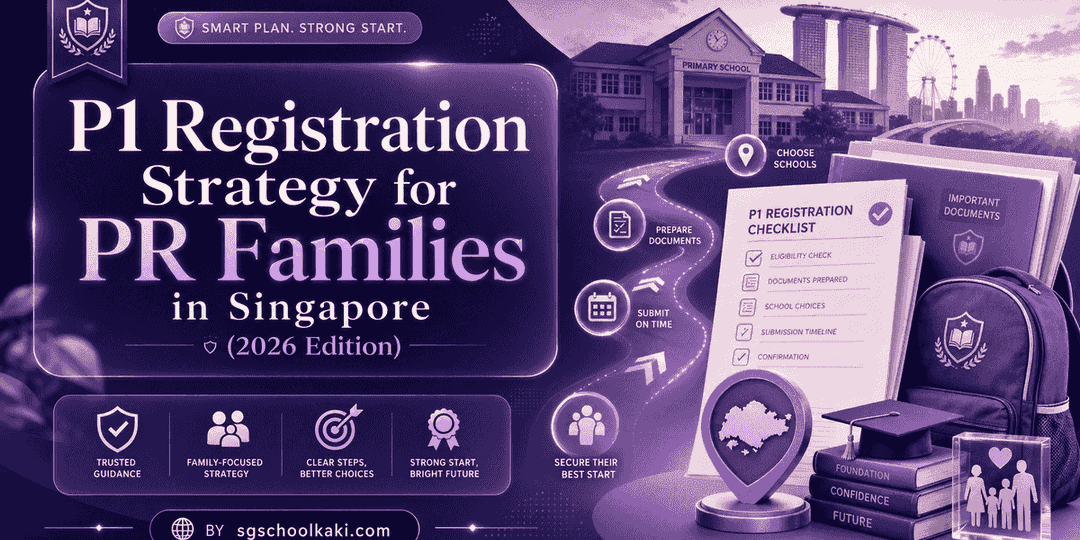
Permanent Resident (PR) families face structurally tighter P1 odds in Singapore than Singapore Citizens (SC). A PR intake cap limits the share of PR places per school, and within Phase 2C and 2C Supplementary balloting, SC children rank above PR children in every distance band. With MOE's 2026 intake reduction, this competition tightens further. This guide explains the rules and a working strategy.
Before you plan: Use the P1 Registration hub & distance calculator to model your child's 1km / 1–2km / beyond-2km bands at each candidate school.
The PR Cap — What It Is
MOE limits the proportion of Permanent Resident children admitted to each primary school under its P1 Registration Framework. This cap applies from Phase 2C and Phase 2C Supplementary — the open phases where most families without special affiliations participate.
Why the cap percentage is not quoted here
MOE has published the PR cap as part of its registration framework documents, but the specific percentage is communicated via infographic rather than as a plain-text number in official press releases or the MOE website. Most credible public sources avoid quoting a number to prevent misattribution. For the authoritative figure, refer to MOE P1 Registration — How to Register .
The practical effect of the cap is significant: even if a PR child qualifies for the within-1km distance band at a given school, they may be deprioritised or excluded from that round of allocation if the school's PR cap has already been filled by other PR applicants. The cap resets per school — it is not a national quota.
What the PR cap means in practice
- Schools with high SC demand fill the PR cap earlyAt oversubscribed schools like Princess Elizabeth Primary or Nan Hua Primary, SC families absorb nearly all places before the PR tier is reached. If the school's PR cap is then hit, remaining PR applicants are unsuccessful regardless of their distance band.
- Under-subscribed schools are largely unaffectedAt the majority of Singapore primary schools (those that do not ballot), the PR cap is rarely reached. PR families registering for these schools have similar outcomes to SC families.
- Cap applies school-by-schoolEach school has its own PR cap calculation. There is no single national PR admission quota. A PR child unsuccessful at one school can still succeed at another.
Citizenship Priority Within Distance Bands
Within each Home-School Distance (HSD) tier, Singapore Citizens are prioritised first. PR children only enter the ballot after all SC children in the same band have been placed. MOE's six-tier priority order for Phase 2C is:
SC living within 1km
Highest priority — admitted first
SC living between 1km and 2km
Considered after within-1km SC are placed
SC living outside 2km
Lowest SC priority tier
PR living within 1kmPR — cap applies
First PR tier — subject to PR cap
PR living between 1km and 2kmPR — cap applies
Subject to PR cap and remaining capacity
PR living outside 2kmPR — cap applies
Lowest priority — rarely reached at popular schools
The counter-intuitive result
A PR child living within 1km of a popular school can lose a place to a SC child living between 1km and 2km of the same school — because SC priority overrides distance priority across citizenship tiers. At highly oversubscribed schools, the school may fill entirely at the SC-within-1km tier, and PRs at any distance receive no places at all.
Realistic Odds by Distance Band
Using 2025 P1 Registration balloting data, we can observe the real-world impact on PR families. In 2025, Phase 2C balloting occurred at 81 schools. Of those 81 ballots:
| Ballot Tier | Schools (2025) | PR implication |
|---|---|---|
| SC within 1km | 59 | School filled before any PR tier — zero PR places |
| SC between 1–2km | 8 | School likely full before PR tier; possible PR cap reached |
| PR within 1km | 6 | All SC placed; ballot among nearby PRs — PR cap may apply |
| SC outside 2km | 3 | High demand schools — PRs very unlikely to succeed |
| PR between 1–2km | 1 | Rare — all SC and nearby PRs placed; capacity remaining |
The data shows that at 59 out of 81 schools that balloted in 2025, the school filled entirely within the SC-within-1km tier. For PR families targeting any of those 59 schools, there were likely zero places remaining when their tier was reached — regardless of how close to the school they lived.
Strategy implication: PR families should treat oversubscribed schools as long shots and weight their backup school list heavily. Most (approximately 75 out of 179) primary schools did not ballot at all in 2025 — meaning the majority of schools had more places than applicants, and PR families faced no special disadvantage there.
Which Phases Are Available to PR Families?
PR families can participate in all phases except Phase 3, which is reserved for international students (non-PR foreigners) only. Here is a summary:
Phase 1 Yes
Sibling priority — if your child has a sibling currently in the school. No balloting in Phase 1.
Phase 2A Yes
Alumni, school staff, SAC/school advisory committee members, and MOE Kindergarten (MK) connections. No 2A1/2A2 split — Phase 2A is a single consolidated phase.
Phase 2B Yes
Community volunteering, church/clan/educational institution links. Volunteerism is the most accessible route here — see the Phase 2B Volunteer guide.
Phase 2C Yes — with limitations
Open registration. PR cap applies per school. SC children hold priority over PR children within every distance band.
Phase 2C Supplementary Yes — with limitations
PR cap continues from Phase 2C. MOE may post-assign children who remain unplaced after 2C Supplementary.
Phase 3 NO
Phase 3 is for international students (non-PR, non-SC foreigners) only. PR families do not participate.
2026 Tightening: Intake Reduction Impact
MOE has announced a gradual reduction in P1 intake starting with the 2026 exercise, reflecting declining birth cohorts. This reduction affects total places at most schools — and for PR families, the effect compounds:
Tactical change for 2026: PR families must spread risk across more candidate schools than in previous years. A strategy that relied on a single popular school within 1km is significantly riskier in 2026 than it was in 2024.
Read our full breakdown: P1 Intake Reduction 2026 — What Changes and What It Means
Working PR Strategy for 2026
Given the constraints above, here is a practical, evidence-based strategy for PR families entering the 2026 P1 Registration Exercise:
- 1
Maximise earlier phases — avoid arriving at Phase 2C unprepared
Phase 2C is where PR families face the largest structural disadvantage. Use Phase 1 (sibling priority), Phase 2A (alumni or staff connections), and Phase 2B (volunteering) wherever possible. These phases are lower-competition and do not trigger the SC-over-PR ordering in the same way.
- 2
Volunteer for Phase 2B — deadline is typically July 2025 for 2026 exercise
Phase 2B volunteer slots require at least 40 hours of approved community service at the school by the specified deadline. If you have not already volunteered, it is worth checking availability at less-popular nearby schools. See our Phase 2B Volunteer Guide for details on the application process.
Phase 2B Volunteer Guide - 3
Build a backup list of 5+ schools — include some with surplus capacity
Identify at least five candidate schools — your preferred choice and several backup schools that historically do not ballot (i.e., schools with vacancies remaining after Phase 2C). Use the P1 Registration hub to check 2024 and 2025 vacancy data for each school on your list.
P1 Registration hub & distance calculator - 4
Verify 30-month residency for distance priority
Your child's Home-School Distance (HSD) category is based on the registering parent's NRIC address. To claim within-1km priority, you must reside at that address for at least 30 months from the start of the P1 Registration Exercise. Ensure your residency is established well in advance.
- 5
Model all candidate schools using the P1 Registration hub
Enter your postal code and instantly see which schools are within 1km, 1–2km, and beyond 2km. Cross-reference each school's 2024 and 2025 balloting history to assess the realistic likelihood of a PR child gaining a place.
Check distance and odds now - 6
Prepare a Phase 2C Supplementary plan
If your preferred school is oversubscribed and you are unsuccessful in Phase 2C, Phase 2C Supplementary is the final opportunity before MOE post-assignment. Read our deep-dive to understand the process and which schools typically have remaining vacancies.
Phase 2C Supplementary deep dive - 7
If unplaced after 2C Supplementary, be ready for MOE post-assignment
Children who remain unplaced after Phase 2C Supplementary are assigned a school by MOE. Parents have no choice over the school. MOE assigns based on available vacancies, which may be further from home. Having a realistic expectation of this outcome reduces stress — and most PR families who plan carefully avoid it.
Schools Where PR Families Have Better Odds
MOE does not publish per-school PR acceptance statistics, so we infer odds from total vacancy and applicant ratios. Schools where PR families have consistently better odds share a common profile: they have vacancies remaining after Phase 2C closes in most years.
Characteristics of PR-friendly schools
- Historically did not ballot in Phase 2C (2024 + 2025 data)
- Vacancies remaining after Phase 2B — low Phase 2B oversubscription
- Located in newer or less densely populated estates (Tengah, Punggol West, Sengkang)
- Not associated with popular brand affiliation (no well-known alumni cluster)
Use the P1 Registration hub to check vacancy history for specific schools near your home address. Filter for schools that had zero or minimal balloting in 2024 and 2025 — these are the schools where a PR child has a realistic chance in Phase 2C.
Frequently Asked Questions
Is there a published PR cap percentage for P1 registration?
MOE has published the PR cap as part of its registration framework documents, but the specific percentage is communicated via infographic rather than as a plain-text number. Most credible public sources avoid quoting a figure to prevent misattribution. Refer to MOE's official P1 Registration page for the authoritative infographic.
Do PR children have any priority over international students in P1 registration?
Yes. PR families can register in Phases 1, 2A, 2B, 2C, and 2C Supplementary — the same phases as Singapore Citizens. International students (non-PR foreigners) may only register in Phase 3, after all citizen and PR places have been allocated. This is a significant advantage for PR families.
What if my child is born to one PR parent and one SC parent?
Your child's registration status follows their registered citizenship at the time of the P1 registration exercise. If your child holds Singapore Citizenship (SC), they register with full SC priority. If they hold only PR status, they register as PR. Check your child's ICA records before the exercise opens.
Can PR families apply for deferment from P1 registration?
Yes — the deferment application process applies equally to Singapore Citizens and Permanent Residents. For the 2026 P1 Registration Exercise, the deferment application deadline is 31 May 2026. Families must apply before this date regardless of citizenship status.
Related Guides
P1 Registration Hub
Full 2026 calculator + phases breakdown + distance checker for all 179 schools.
Distance Priority (HSD) Guide
How the 1km and 2km bands work, 30-month rule, and how to check your category.
Phase 2B Volunteer Guide
Step-by-step guide to qualifying for Phase 2B through community volunteering.
Phase 2C Supplementary Explained
What happens in 2C Supp, which schools typically have remaining vacancies, and what to expect.
P1 Intake Reduction 2026 Analysis
MOE's gradual intake reduction — what changes, which schools are affected, and how it affects PR families specifically.
Sources: P1 Registration framework and PR cap: MOE P1 Registration — How to Register. Distance priority: MOE P1 Registration — Distance. Balloting data: MOE P1 Registration Results 2025. Citizenship and PR status: Immigration and Checkpoints Authority (ICA).