


Full SBB Posting Groups Singapore:
PG1, PG2 & PG3 Explained for Parents
No more Express, Normal (Academic) or Normal (Technical). Here's what Posting Groups PG1/PG2/PG3 and subject levels G1/G2/G3 actually mean for Secondary 1 posting today.
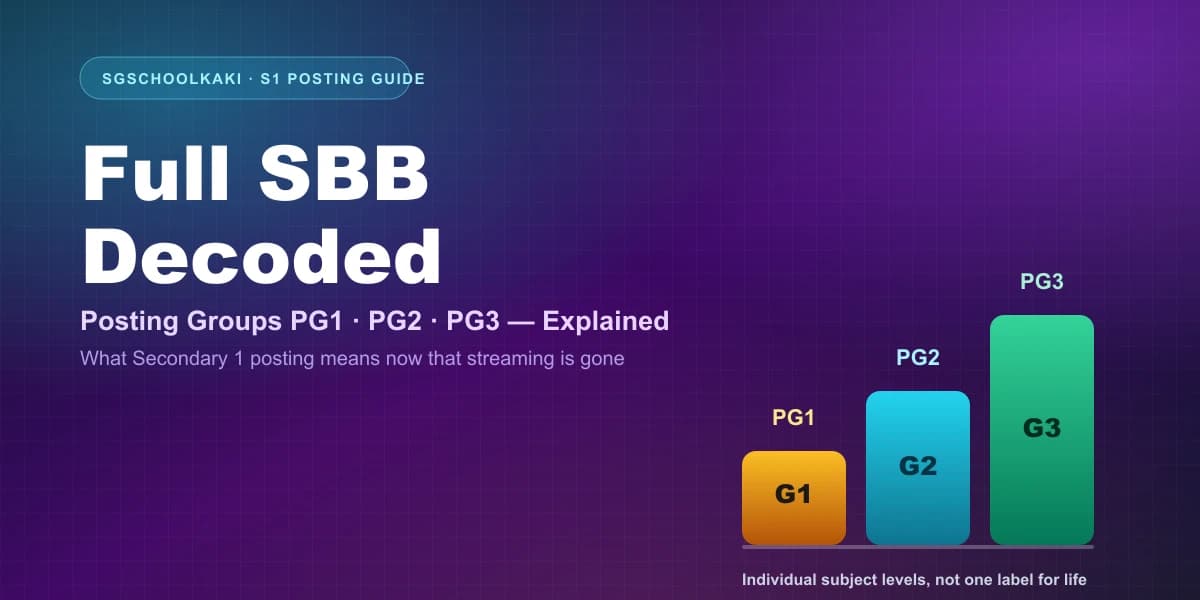
Since the 2024 Secondary 1 cohort, Express, Normal (Academic) and Normal (Technical) streams no longer exist[1]. Under Full Subject-Based Banding (Full SBB), students are posted via Posting Groups PG1, PG2 or PG3 based on their PSLE score, then take each subject individually at a G1, G2 or G3 level[2].
The Posting Group only decides your child's starting subject levels — not a fixed academic label for the next four years. This guide breaks down exactly how the mapping works, how your child can move up a subject level, and what changes at the finish line with the new national exam certificate.
Streaming (before 2024) vs. Full SBB (from 2024)
- •One label — Express, N(A) or N(T) — for all subjects, for all 4–5 years
- •Separate exam tracks: GCE O-Level or N-Level, on different timetables
- •Form classes largely grouped by stream
- •Moving to a harder subject level meant a formal stream transfer
PG1, PG2 and PG3 at a glance
Posting Groups are mapped from the existing PSLE score ranges of the three former streams[1]. Your child's Posting Group decides their starting subject levels in Secondary 1 — not a permanent ceiling.
The PSLE score bands shown are MOE's fixed Posting Group mapping, unchanged since the 2019 Annex A scoring update[5] — scores of 21–22 and 25 are “choice bands” where the student may opt into either adjacent Posting Group. What changes every year instead is each individual school's own Cut-Off Point (COP) — the score needed to get into that specific school — which is only confirmed after that year's S1 Posting Exercise concludes[6].
Your Posting Group is where your child starts — not where they're stuck. A PG2 student who scores AL5 or better in a PSLE Standard subject can take that subject at G3 from day one of Secondary 1.
How your child can move up a subject level
Unlike streaming, subject levels under Full SBB are decided subject by subject, not in one lump label. Two specific score thresholds let a student start at a higher level than their Posting Group's default[2]:
A student posted through PG2 who scored AL5 or better for a PSLE Standard subject can take that subject at the G3 level from Secondary 1 — even while their other subjects start at G2.
A student posted through PG1 who scored at least AL6 for a PSLE Standard subject, or an A for a PSLE Foundation subject, can take that subject at the G2 level from Secondary 1.
Mixed form classes
Students are grouped into mixed form classes with peers from different Posting Groups, not segregated by stream[2]. Around one-third of curriculum time is spent together as a form class on six common curriculum subjects; for the rest, students attend subject-specific classes grouped by their individual level (G1, G2 or G3) for that subject[7].
PSLE score to Posting Group mapping
| Posting Group | Mapped From (Former Stream) | Starting Subject Level | PSLE Score Band |
|---|---|---|---|
| PG3 | Former Express | Mostly G3 | PSLE Score 4–20 Scores of 21–22 are a choice band — the student may opt into PG3 instead of PG2. |
| PG2 | Former Normal (Academic) | Mostly G2 | PSLE Score 23–24 Scores of 21–22 or 25 are choice bands — the student may opt into PG2 instead of PG3 or PG1. |
| PG1 | Former Normal (Technical) | Mostly G1 | PSLE Score 26–30 (with AL7+ in English & Maths) A score of 25 is a choice band — the student may opt into PG1 instead of PG2. |
Source: MOE Full SBB overview[1] and the 2019 PSLE scoring announcement (Annex A)[5], which fixed this Posting Group mapping as standing policy. Each school's own Cut-Off Point (COP) is a separate figure that is set only after that year's S1 Posting Exercise concludes and varies by school and cohort[6].
The Singapore-Cambridge Secondary Education Certificate (SEC)
- 1.From 2027, the separate GCE O-Level and N-Level certificates are replaced by one national exam and certificate — the SEC[3].
- 2.The SEC lists each subject alongside the level it was taken at — G1, G2 or G3 — on one certificate, instead of separate O-Level and N-Level paper slips[3].
- 3.Exam periods are consolidated: English Language moves to September alongside Mother Tongue Language written papers, with one common exam period starting October and results released together the following January[3].
- 4.The 2024 S1 cohort is the first to sit the SEC in 2027; every S1 cohort since has been on Full SBB and will follow the same SEC track[3].
The S1 posting process, step by step
For the 2025 PSLE cohort, choices were submitted online from 25 November to 1 December 2025, and results were released on 19 December 2025 at 9am[8]. The overall process repeats on a similar calendar each year.
Source: MOE S1 Posting process page[9], 2025 S1 Posting Results press release[8], and MOE's appeal for school transfer criteria[10].
A starting point, not a life sentence
Full SBB in one sentence
Your child's Posting Group decides where they start not where they finish
You can move up a subject level with strong PSLE results in that subject, and every subject stands on its own — a G1 in Math doesn't cap your Science or English.
Focus school-choice conversations on fit — CCAs, location, culture — rather than fearing a single label. Ask the school how many students move up a subject level each year.
Questions parents ask us most
What PSLE score gets my child into Posting Group 3 (PG3)?
PG3 is mapped from the former Express stream's PSLE score range: a PSLE Score of 4 to 20 (on the 4–32 scale) is posted to PG3. A score of 21 or 22 falls in a choice band, where the student may opt into PG3 instead of PG2. This mapping is fixed MOE policy, unchanged since 2019 — it's each school's own Cut-Off Point (a separate figure) that varies every year, not this PG mapping.
What PSLE score gets my child into Posting Group 2 (PG2)?
PG2 is mapped from the former Normal (Academic) stream's PSLE score range: a PSLE Score of 23 or 24 is posted to PG2 outright. Scores of 21–22 and 25 are choice bands, where the student may opt into PG2 instead of PG3 (for 21–22) or instead of PG1 (for 25). This mapping is fixed MOE policy — it's each school's own Cut-Off Point that changes every year, not this PG mapping.
What PSLE score gets my child into Posting Group 1 (PG1)?
PG1 is mapped from the former Normal (Technical) stream's PSLE score range: a PSLE Score of 26 to 30, with AL7 or better in both English Language and Mathematics, is posted to PG1. A score of 25 falls in a choice band, where the student may opt into PG1 instead of PG2. This mapping is fixed MOE policy, unchanged since 2019 — it's each school's own Cut-Off Point that varies year to year, not this PG mapping.
Can my child in PG2 take subjects at the more demanding G3 level?
Yes. A student posted through PG2 who scores AL5 or better for a PSLE Standard subject can take that specific subject at the G3 level from Secondary 1, even while their other subjects start at G2.
Can my child in PG1 take subjects at the G2 level?
Yes. A student posted through PG1 who scores at least AL6 for a PSLE Standard subject, or an A for a PSLE Foundation subject, can take that subject at the G2 level from Secondary 1.
Will my child only be grouped with other students from the same Posting Group?
No. Students are placed in mixed form classes with peers from different Posting Groups. Around one-third of curriculum time is spent together as a form class on a set of six common curriculum subjects, while other subject periods group students by their individual subject level (G1, G2 or G3) for that subject.
What exam will my child sit at the end of secondary school now?
From 2027, all secondary students will sit the Singapore-Cambridge Secondary Education Certificate (SEC) — a single common national exam and certificate that lists each subject at the G1, G2 or G3 level it was taken at, replacing the separate GCE O-Level and N-Level certificates.
How does Secondary 1 (S1) posting actually work?
Parents submit up to 6 preferred secondary school choices online via the S1 Portal. MOE then posts students based on PSLE score, then — for tied scores — citizenship status, choice order, and computerised balloting where needed. Results are released via the S1 Portal, SMS, or at the primary school.
“PG1, PG2, PG3 are new names for a familiar idea — but the subject-by-subject flexibility is genuinely new. Ask your child's school how subject-level reviews work before assuming anything is fixed.”
— A note for worried parents
Continue Your Secondary School Journey
PSLE Results & S1 Posting Guide
The full walkthrough of PSLE scoring and how S1 posting choices work.
Best Secondary Schools Singapore 2026
How to choose a secondary school that fits your child, by location and programme.
Secondary School CCA Guide
200+ CCAs across Singapore secondary schools, explained.
IP Schools Singapore 2026
How the Integrated Programme bypasses the O-Level/SEC exam entirely.
DSA Singapore 2026 Guide
An alternative route into secondary school before the PSLE posting exercise.
2028 JC Admission: L1R4 Changes
What happens after the SEC — how post-secondary admission criteria are changing too.
Singapore Exam Schedule 2026
PSLE, O-Level and A-Level exam dates for the current academic year.
Secondary School Database & COP
Browse all 147 secondary schools with PSLE Cut-Off Points by Posting Group.
PSLE Score Calculator
Work out your child's PSLE Score (AL sum) and see which Posting Group range it historically falls into.
Sources
- [1] MOE — Curriculum for Secondary Schools Under Full SBB
- [2] MOE — Full Subject-Based Banding FAQ
- [3] MOE — Infosheet 2: Full SBB-Related Changes on SEC Examination Timetable
- [4] MOE — Syllabus for Secondary Schools Offering Full SBB
- [5] MOE — Updates to PSLE 2021 Scoring System (Annex A placement criteria)
- [6] MOE — Understand PSLE Score Ranges
- [7] MOE — Learning Together with Different Strengths and Needs (COS 2026)
- [8] MOE — 2025 Secondary 1 Posting Results (press release)
- [9] MOE — Secondary 1 (S1) Posting Process
- [10] MOE — Appeal for School Transfer (Serious Medical Conditions)
Keep learning with SGSchoolKaki
Ask KlickAI, our AI tutor
Stuck on a concept? Get a step-by-step explanation aligned to the Singapore syllabus. Free to start.
Try KlickAI
Practise real exam-style questions
Past-paper style questions with worked solutions, so students learn from every answer. Free practice available.
Open the Question Bank
Written by
SGSchoolKaki Education Team
Our team of ex-MOE teachers, private tutors and education data analysts brings 16+ years of combined experience.