
How Singapore Schools Are Preparing
Students for an AI Future
MOE's plan isn't to ban AI or worship it — it's the “Four Learns.” Here is what that means for your child, from primary school today to university in 2027.
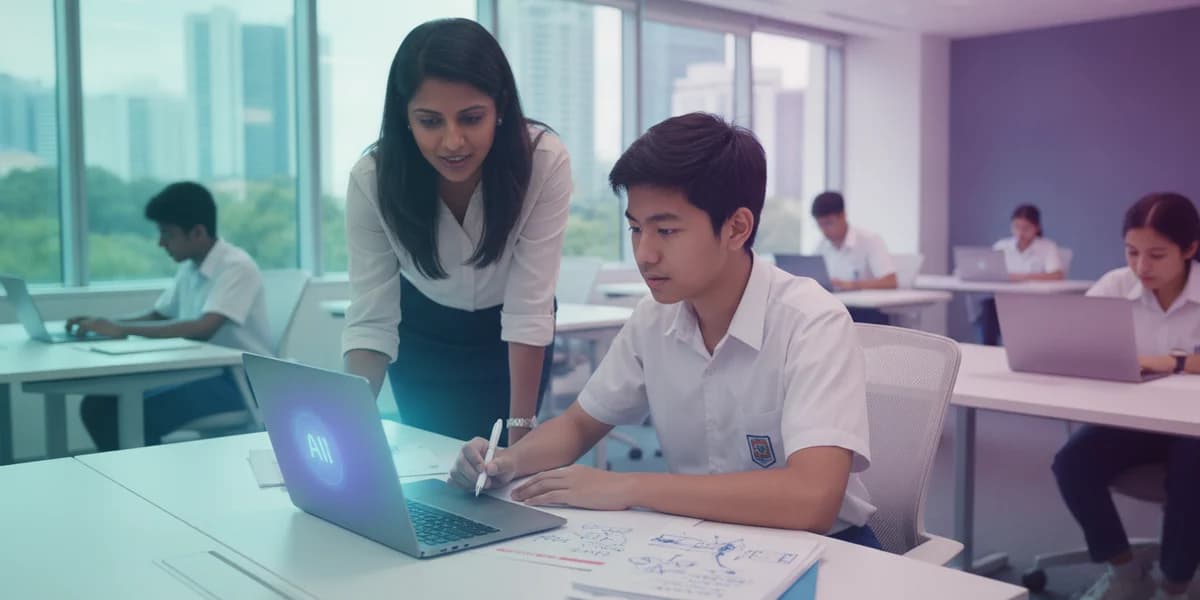
Singapore isn't banning AI in schools, and it isn't letting students loose on it either. At the 2026 Committee of Supply debate[2], MOE laid out its actual plan: the “Four Learns” — learn about AI, learn to use AI, learn with AI, and most importantly, learn beyond AI[2].
This piece is the forward-looking half of the story. For how AI already works inside classrooms today — the Student Learning Space, age-tiered rules, the tools teachers use — see our companion post, AI in Singapore Schools: How MOE Is Using AI for Students in 2026. Here, we look at where MOE is taking this next — from Code for Fun to compulsory AI modules at university.
The “Four Learns”
This is the single framework behind everything else in this post. MOS Jasmin Lau introduced it at COS 2026, and it now shapes MOE's AI plans from primary school all the way to university[2].
Understand what AI actually is, how it works, and what it can and can't do — the basic literacy underneath everything else.
Practical, hands-on skills with real AI tools — the same instinct behind updating programmes like Code for Fun.
Treating AI as a study partner — for feedback, practice and exploring ideas, alongside teachers, not instead of them.
The human edge: judgement, character, and the kind of thinking AI can't do for your child.
“We want every student to ‘learn about AI, learn to use AI, learn with AI, and most importantly, learn beyond AI’.”[2]
The 2026 Committee of Supply debate
MOE's Committee of Supply (COS) debate for 2026 was held on 3 March 2026[1]. The “Four Learns” framework was set out there by Jasmin Lau, Minister of State for Education[2]. Singapore's Minister for Education is Desmond Lee, with David Neo and Dr Janil Puthucheary serving as Senior Ministers of State for Education[8].
In the classroom now — and by 2027
MOE's COS 2026 announcements set out three concrete moves for schools[5].
Code for Fun — updated
MOE's coding programme is being updated to strengthen students' AI skills, and will be made available to all schools in 2027[5].
Cyber Wellness — deepfakes
Cyber Wellness lessons have been updated to cover identifying deepfakes and validating AI-generated information[5].
Learning Assistant & more
MOE delivers AI through the Student Learning Space: the Learning Assistant (LEA), Adaptive Learning System (ALS, for Maths & Geography), Feedback Assistants and an Authoring Copilot for teachers[7].
Want the day-to-day mechanics?
Our companion post covers exactly how LEA and ALS work, which age groups use AI directly, and what the guardrails look like — read the full breakdown here.
“Learn beyond AI” — the part that matters most
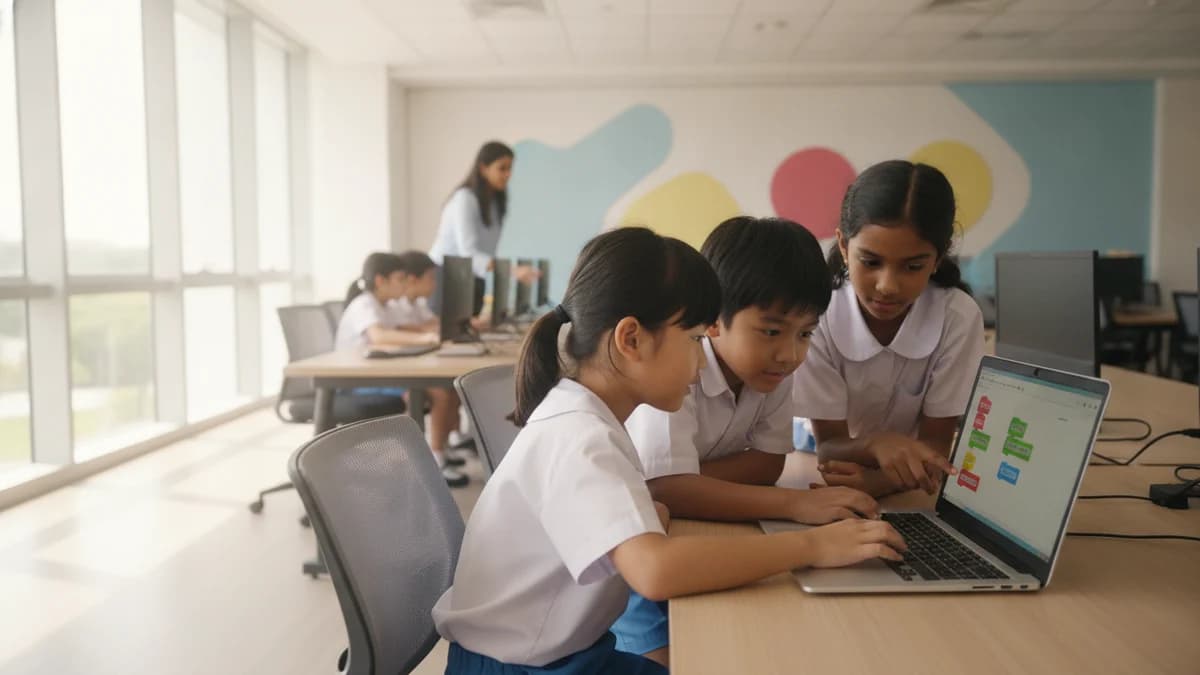
MOE keeps returning to one idea: AI can generate an answer, but it cannot do the thinking that matters. Jasmin Lau put it this way at COS 2026[2].
“If AI can generate answers in seconds, our students must learn to ask better questions. If AI can process vast amounts of data, our students must develop judgement. And if AI can imitate language, our students must cultivate character.”[2]
— Jasmin Lau, Minister of State for Education, COS 2026
Better questions
AI answers fast. The skill that matters is knowing what to ask it in the first place.
Judgement
AI processes data at scale. Deciding what to trust and act on is still a human call.
Character
AI can imitate language, but not the values and integrity behind how someone actually acts.
Catalyst, not shortcut — and the real risk
MOE isn't naive about the downside. Speaking at the Straits Times Education Forum on 1 April 2026, Minister Desmond Lee was direct about both the promise and the danger[3].
“If we treat AI as a shortcut, to simply bypass thinking, we will diminish the very purpose of education. But if we treat AI as a catalyst, a tool to sharpen what truly matters in education, it can strengthen our IHLs and strengthen our people.”
Desmond Lee, ST Education Forum, 1 Apr 2026
“There is also a risk that AI may become a shortcut that bypasses thinking and learning, and causes cognitive offloading, and that students become overly reliant or trusting of AI output.”
Desmond Lee, same forum
Researchers agree the skills question runs deeper than tool use. Emeritus Professor Looi Chee Kit of the National Institute of Education (NIE, NTU) puts it this way:
“Ensuring we engage with the societal and ethical implications of living in an AI-driven world will better prepare all our children and young people to use technology for good.”[6]
— Emeritus Prof Looi Chee Kit, NIE (NTU)
AI should sharpen thinking, not replace it
the balance MOE is trying to strike
AI must never replace deep, human learning in our schools and IHLs — that principle is the thread running through every policy in this post.
Use AI to check your thinking, not replace it — the first draft should come from you.
Watch for cognitive offloading — if AI is always doing the thinking, your child isn't practising it.
Desmond Lee, NUS120 Distinguished Speaker Series, 21 May 2026[4].
The lifelong AI pipeline: school → university → career
The “Four Learns” doesn't stop at graduation. From AY2027, it becomes a compulsory part of higher education[4] — backed by a 2026 roadmap of smaller moves that build up to it.
The 2026 → AY2027 roadmap
| When | Milestone | Detail |
|---|---|---|
| Feb 2026 | Budget 2026 — AI literacy commitment | Strengthen AI literacy for students across all IHLs, and give Singaporeans who take selected AI training courses six months of free access to premium AI tools. |
| Q2 2026 | AI Readiness Tool launches | SkillsFuture Singapore and the Singapore Institute of Technology roll out a self-diagnostic tool on MySkillsFuture — gauge your AI-readiness and get course recommendations. |
| May 2026 | "Update to NAIS" published | 10 refreshed priorities added to Singapore's National AI Strategy (NAIS 2.0, first launched Dec 2023) — the national backdrop to the schools-to-work AI pipeline. |
| H2 2026 | Alumni AI course discounts | All Institutes of Higher Learning offer selected AI courses to their own alumni at a significant discount, for one year. |
| AY2027 | Compulsory AI modules at all IHLs | Every incoming student at the Autonomous Universities, Polytechnics and ITE takes a baseline AI-competency module — built on the same "Four Learns" structure used in schools, via two purpose-built frameworks. |
Budget 2026 (delivered Feb 2026) is where the AI-literacy and free-premium-tools commitments above come from[9]. National context: Singapore's National AI Strategy 2.0 (NAIS 2.0) launched Dec 2023, with an “Update to NAIS” adding 10 refreshed priorities in May 2026[10].

What you can do at home
Nothing here needs new software or a big talk. It's mostly about the questions you ask your child.
Seven small habits that build the “learn beyond AI” edge
- 1.Treat AI answers as a first draft — ask your child to check it, not just copy it.
- 2.Ask them to explain it in their own words — if they can't, the thinking didn't actually happen.
- 3.Praise a good question as much as a fast answer — that's the whole point of “learn beyond AI.”
- 4.Use school-provided tools like SLS rather than open consumer chatbots for schoolwork.
- 5.Build offline curiosity — reading, conversation, and problems with no AI in the room at all.
- 6.Talk about deepfakes and misinformation — this is now part of updated Cyber Wellness lessons, so reinforce it at home.
- 7.Remember the goal isn't “no AI” — it's a child who can question, judge, and act with character alongside it.
Frequently asked questions
Is Singapore banning AI in schools?
No. MOE is not banning AI, and it is also not letting students use AI without limits. At the 2026 Committee of Supply debate (3 March 2026), Minister of State for Education Jasmin Lau set out MOE's approach as the "Four Learns": students should learn about AI, learn to use AI, learn with AI, and most importantly, learn beyond AI. The goal is AI literacy and judgement, not avoidance or unlimited access.
What are MOE's 'Four Learns'?
The "Four Learns" is MOS Jasmin Lau's framing (COS 2026) for how Singapore students should engage with AI: learn about AI (understand what it is and how it works), learn to use AI (practical tools and skills), learn with AI (as a study and learning partner), and — most importantly — learn beyond AI, meaning the human skills AI cannot replace: asking better questions, developing judgement, and cultivating character.
What is Code for Fun and when do all schools get it?
Code for Fun is MOE's coding and computational-thinking programme for primary and secondary students. According to MOE's COS 2026 announcements, it is being updated to strengthen students' AI skills, and will be made available to all schools in 2027.
Will my child be forced to study AI in university or polytechnic?
From Academic Year 2027, all incoming students at the Autonomous Universities, Polytechnics and ITE will take a compulsory baseline AI-competency module. MOE developed two competency frameworks for this — one for the Autonomous Universities and one for the Polytechnics and ITE — both built on the same "Four Learns" structure used in schools.
How can I help my child prepare for an AI future?
MOE's own framing points the way: treat AI answers as a first draft to question, not a final answer to copy. Praise good questions as much as fast ones, talk about deepfakes and misinformation (now part of updated Cyber Wellness lessons), and use school tools like the Student Learning Space alongside real conversation at home about judgement and character — the "learn beyond AI" part MOE calls most important.
SGSchoolKaki tools built the same way
Free daily practice and MOE-aligned calculators, plus KlickAI — an AI tutor that asks guiding questions instead of just handing over answers.
Question Bank
Free daily practice for PSLE, O-Level and A-Level — real thinking, not copy-paste answers.
KlickAI — AI Tutor
Asks guiding questions, never just hands over the answer — the “learn beyond AI” spirit, built in.
MOE School Calendar
Official MOE term dates, holidays and key milestones for the whole school year.
Continue reading
AI in Singapore Schools Today
How LEA and ALS actually work inside SLS, and the age-tiered rules that govern student AI use.
Singapore's Smartphone Ban in Schools
What changed, which levels are affected, and how it fits alongside MOE's AI plans.
2028 JC Admission: L1R5 to L1R4
Everything that changes (and stays) when JC admission drops to 5 subjects.
Sources & Further Reading
- [1]MOE press release: “We Learn for Life, Together” (COS 2026), 3 Mar 2026
- [2]Jasmin Lau, MOS Education — MOE COS Debate 2026 response, 3 Mar 2026
- [3]Desmond Lee — ST Education Forum “AI in Higher Education – Hype or Hope”, 1 Apr 2026
- [4]Desmond Lee — NUS120 Distinguished Speaker Series, 21 May 2026
- [5]MOE COS 2026 Announcements
- [6]NIE (NTU) — “Teaching AI in schools needs to go beyond a skills-based approach”
- [7]MOE — Artificial Intelligence in Education
- [8]MOE — Organisation Structure
- [9]Singapore Budget 2026 — “Harness AI As A Strategic Advantage”
- [10]Smart Nation — National AI Strategy
Keep learning with SGSchoolKaki
Ask KlickAI, our AI tutor
Stuck on a concept? Get a step-by-step explanation aligned to the Singapore syllabus. Free to start.
Try KlickAI
Practise real exam-style questions
Past-paper style questions with worked solutions, so students learn from every answer. Free practice available.
Open the Question Bank
Written by
SGSchoolKaki Education Team
Our team of ex-MOE teachers, private tutors and education data analysts brings 16+ years of combined experience.