


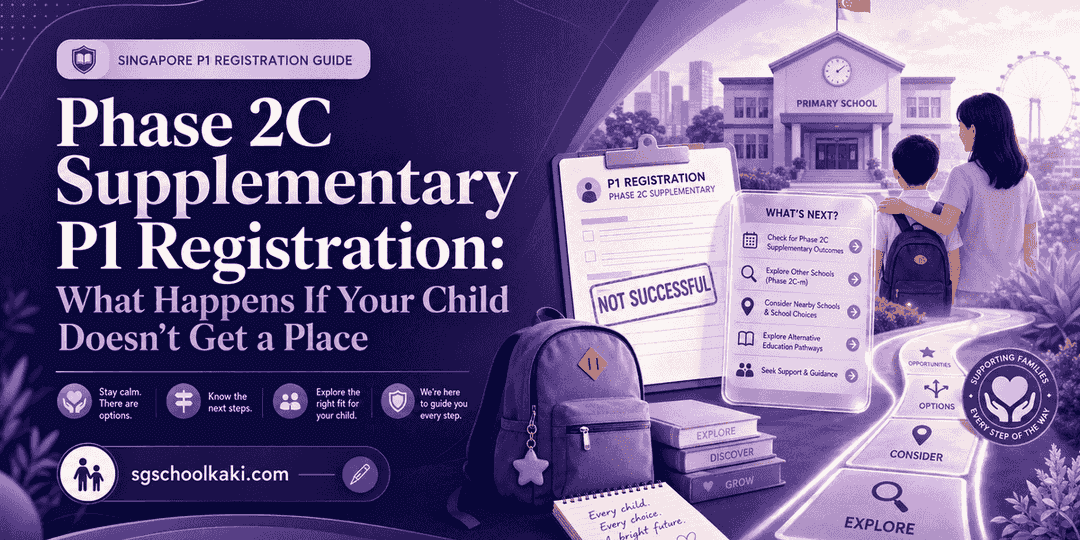
Phase 2C Supplementary is the final phase of Singapore's P1 Registration for Singapore Citizens and Permanent Residents who did not secure a place in any earlier phase. It runs after Phase 2C results are released and draws from the same 40-place pool. If your child remains unplaced after Phase 2C Supp, MOE will post them to a primary school with remaining vacancies — you do not choose. This guide explains the rules, your real options, and how to maximise your chances.
What Phase 2C Supplementary Actually Is
Singapore's P1 Registration runs in sequential phases, each targeting a specific group of children. Phase 2C Supplementary is the last phase open to Singapore Citizens (SC) and Permanent Residents (PR). It exists specifically to give families a final chance to secure a school place before MOE steps in and posts unplaced children administratively.
P1 Registration Phase Order (2026)
Phase 2C Supplementary 2026 (CONFIRMED by MOE): Registration runs 17–18 August 2026 (9am Mon to 4:30pm Tue), with results announced 27 August 2026. Latest confirmation on the MOE P1 Registration Timeline , as dates are confirmed annually.
Eligibility is simple: any SC or PR child who has not secured a primary school place in any earlier phase may register in Phase 2C Supplementary. There is no additional qualification required — it is the safety net of the entire registration system.
Who Ends Up in Phase 2C Supplementary
The vast majority of families secure a school place well before Phase 2C Supp. This phase is relatively small in cohort size — typically just a few percent of the total P1 intake. Families who arrive here generally fall into one of four groups:
Lost the Phase 2C ballot
Applied to a popular school in Phase 2C but did not win the ballot. This is the most common reason — oversubscribed schools run out of the 40 reserved places before the family's turn.
Didn't apply in earlier phases
A small number of families — through oversight or personal circumstance — do not participate in any earlier phase and enter the process at this final stage.
Overseas-returning families
Families who returned to Singapore after the earlier phases had closed. Late registration is possible only in Phase 2C or Phase 2C Supp.
New residents mid-year
Families who obtained Singapore Citizenship or PR status after the earlier phases had concluded and were therefore ineligible for those phases.
Reassurance: Reaching Phase 2C Supp is not unusual and not a failure. Thousands of families go through this process every year, and the vast majority secure a school place — either through their own application or via MOE posting.
The 40-Place Pool — Shared with Phase 2C
This is the most important structural fact to understand about Phase 2C Supp: it does not have its own separate pool of places. Instead, it shares the same 40 reserved places per school that were used in Phase 2C.
How the 40-Place Pool Works
Total places reserved for Phase 2C and 2C Supp combined
MOE sets aside 40 places at every primary school for these two open phases. This number is fixed regardless of school size.
Example: Phase 2C fills 35 of those 40 places
A popular school might use nearly all 40 places in Phase 2C itself, leaving only 5 places (or fewer) for Phase 2C Supp.
Only 5 places remain for Phase 2C Supp at that school
If more than 5 children apply to this school in Phase 2C Supp, a ballot is held. If all 40 places were used in Phase 2C, there are zero Phase 2C Supp places available here.
The practical consequence is stark: the most popular schools — the ones that already ran a ballot in Phase 2C — will have very few or zero places left for Phase 2C Supp. Families in this phase need to cast a wider net and look at schools that historically retain vacancies into the final phases.
Want to know which schools had 2C Supp vacancies? See our 2025 oversubscribed schools analysis — schools that weren't fully subscribed in Phase 2C will also have had vacancies in Phase 2C Supp.
PR Cap Applies in Phase 2C Supplementary
The PR intake cap introduced by MOE — which limits the proportion of PR children admitted in each phase — continues to apply in Phase 2C Supplementary. This cap was introduced to ensure that SC children are not disadvantaged by large PR cohorts at popular schools.
What This Means for PR Families
The cap is cumulative: The PR intake limit is applied across all phases. By Phase 2C Supp, many schools may already be at or near their PR cap, meaning PR children face extremely limited options.
MOE does not publish the exact cap percentage in text form — it appears only in an infographic in the official P1 guide. The practical effect, however, is well-documented: PR families have a narrower set of viable schools in Phase 2C Supp than SC families.
Strategy: PR families should aim to secure a school place in Phase 2C or earlier. Relying on Phase 2C Supp as a fallback is higher-risk for PR children than for SC children.
If Your Child Is Still Unplaced After Phase 2C Supp
This is the scenario most parents fear, so let's address it directly — and calmly. If a SC or PR child is still without a primary school place after Phase 2C Supp, MOE will step in and post the child to a primary school that has available vacancies. This is a guaranteed outcome: every SC and PR child will receive a primary school place.
You do not choose the school
MOE selects from schools that still have capacity. You have no input into which school is selected. The selection is administrative, not based on your preferences.
Distance priority does not apply to MOE postings
The Home-School Distance (HSD) categories — within 1km, 1–2km, outside 2km — govern the registration process. They do not apply to MOE administrative postings. Your child could be posted to a school several kilometres from home if that is where vacancies remain.
Vacancies exist at less-popular schools
The most popular schools are full by Phase 2C Supp. Schools with remaining capacity tend to be smaller schools, neighbourhood schools in lower-demand estates, or schools in areas with declining residential populations. These are still good schools — every MOE-registered primary school delivers the same national curriculum.
Can I refuse the MOE-assigned school?
Yes, you may decline. However, your child will then remain unplaced and MOE may post them to another school. Most families accept the assigned school and explore transfer options later. Declining repeatedly does not result in the child being offered a more preferred school — it simply prolongs the process.
Transfer is possible — but not guaranteed
After your child completes P1, you may apply for a school transfer at the start of P2. Transfers are subject to the receiving school having vacancies. The MOE-assigned school is not permanent if a transfer is available.
Keep perspective: MOE-assigned postings after Phase 2C Supp affect a very small number of families each year. The overwhelming majority of SC and PR children are placed through the registration phases themselves. The system is designed so no child goes without a school — this is the guarantee.
How to Maximise Your Chances in Phase 2C Supplementary
Arriving at Phase 2C Supp does not mean your options are exhausted. With the right preparation, most families are able to secure a school they are comfortable with. Here are the six steps that make the biggest difference:
- 1
Build a backup school list of 5+ less-popular schools before Phase 2C
Most parents focus exclusively on their top-choice school. In Phase 2C Supp, that school is likely full. Before Phase 2C results are out, research at least five schools in your area that are historically less oversubscribed. Having a real shortlist means you can act quickly when the Phase 2C Supp window opens.
- 2
Verify your residency address satisfies the 30-month rule
The registering parent's NRIC address determines your Home-School Distance (HSD) category. Distance priority still applies in Phase 2C Supp when there are more applicants than places at a school. Ensure the address is correct and that you will genuinely reside there for 30 months from the start of the P1 Registration Exercise.
- 3
Check school vacancies daily after Phase 2C results are out
MOE publishes daily vacancy updates on its P1 Registration website during the Phase 2C Supp exercise. Monitoring these closely is essential — a school that showed zero vacancies on Day 1 may have slots appear if families withdraw applications. Vacancies can and do change.
- 4
Apply early in the Phase 2C Supp registration window
Phase 2C Supp typically runs over two days. Applying on the first day, as early as possible, maximises your chances at schools where demand is close to but does not exceed supply. When the applicant-to-vacancy ratio is at or below 1, earlier applications are processed first.
- 5
Be ready to register at a school 2–3km from home
By Phase 2C Supp, most schools within 1km of popular residential areas are full. Expanding your search radius to 2–3km — or beyond if necessary — significantly opens up the field. Use our P1 Registration hub to identify schools within your expanded radius that historically retain vacancies.
- 6
Pre-prepare all registration documents before the window opens
Speed matters in Phase 2C Supp. Have the child's birth certificate, both parents' NRICs, proof of residency (utility bill, bank statement, or tenancy agreement dated within the last 3 months), and any relevant supporting letters ready before the registration window opens. Incomplete documents cause delays that may cost you a place.
Real-World Strategy: Building Your Backup School List
The biggest mistake parents make in Phase 2C Supp is having no backup schools researched. By the time Phase 2C Supp opens, you have two days to register. That is not enough time to research schools from scratch.
How to Identify Good Backup Schools
- Look for schools in nearby HDB estates with smaller cohorts
Smaller schools in estates with ageing populations or lower demand tend to have vacancies in Phase 2C and 2C Supp consistently. These are not “bad” schools — they offer smaller class sizes and more individual attention.
- Check historical Phase 2C balloting data
If a school did not run a Phase 2C ballot last year, it almost certainly had Phase 2C Supp vacancies. Schools that never ballot in Phase 2C are your best bet for Phase 2C Supp availability.
- Avoid putting all eggs in one popular-school basket
It is tempting to focus all energy on securing one prestigious school and treating everything else as an afterthought. In Phase 2C Supp, this strategy leaves families unprepared when that school has zero remaining vacancies.
Find Backup Schools Near You with SGSchoolKaki
Our P1 Registration hub shows all 179 primary schools by distance from your home, with historical Phase 2C vacancy and balloting data — exactly what you need to build a reliable backup school list before Phase 2C Supp opens.
Check Schools Near MeWhat If MOE Assigns a School That Doesn't Suit Your Family?
If your child is posted to a school by MOE after Phase 2C Supp and you are not happy with the placement, you have several paths available — none of them quick, but all of them viable.
OPTION 1Accept and apply for a transfer at the start of P2
This is the most common approach. Complete P1 at the assigned school, then submit a school transfer application to MOE before the start of P2. Transfers are subject to the receiving school having vacancies. While not guaranteed, transfers are successfully processed for many families each year — especially if the destination school is within your HSD category and has capacity.
OPTION 2Decline the posting and await another assignment
You may formally decline the MOE-assigned school. Your child will then remain unplaced. MOE will attempt to find another posting, but this is not immediate and you cannot specify your preferred school. Most education advisers caution against this route unless the assigned school is genuinely impractical (e.g., hours of travel time each day).
OPTION 3Appeal on special grounds
Formal appeals against MOE school placements are considered on very narrow grounds — typically medical, welfare, or exceptional family circumstances. There is no general “I would prefer another school” appeal route. If you believe a special circumstance applies, contact MOE directly with supporting documentation.
Practical reality: The vast majority of families who accept an MOE-assigned school find it works out well. P1 is one year. The national curriculum is the same at every school. Many parents who were initially disappointed with an assigned school report that their child settled in happily — and a successful transfer at P2 is a realistic goal for families who genuinely need to move schools.
Frequently Asked Questions
Can I appeal a Phase 2C Supplementary placement?
There is no formal appeals process for Phase 2C Supplementary placements. If MOE assigns your child to a school, you may decline the posting, but your child will then remain unplaced. School transfer applications can be submitted from P2 onwards, but are subject to the receiving school having vacancies and are not guaranteed.
Can I transfer schools later if I'm not happy with the assigned school?
Yes, school transfers are possible but not guaranteed. Transfers are typically considered at the start of Primary 2 or later, subject to the receiving school having vacancies. You submit a transfer request to MOE, and approval depends on available places at the destination school and the reason for the transfer.
What if I refuse the school MOE assigns?
If you decline a MOE-assigned school, your child remains unplaced. MOE may offer another available school, but you cannot specify which one. Most parents accept the assigned school and apply for a transfer at the end of P1. Declining repeatedly does not improve the options offered.
Can I apply to multiple schools in Phase 2C Supplementary?
No. Like all other P1 registration phases, you may only apply to one school per phase. If your chosen school is oversubscribed, you enter a ballot. Choose carefully based on the vacancy data MOE publishes during the Phase 2C Supp window — pick a school where vacancies are confirmed, not one that is likely already full.
Is there a phase after Phase 2C Supplementary for Singapore Citizens and PRs?
No. Phase 2C Supplementary is the last registration phase for Singapore Citizens and Permanent Residents. Phase 3, which follows, is reserved for international students (non-SC/PR). If a SC or PR child is still without a place after Phase 2C Supp, MOE will administratively post the child to a school with remaining vacancies.
More P1 Registration Guides
P1 Registration Hub & Distance Calculator
Check which schools are within 1km and 2km of your home, and see historical balloting data to plan your strategy.
The 1km & 2km Distance Rule Explained
How MOE's Home-School Distance (HSD) categories work, the 30-month residency rule, and how to check your exact distance.
Oversubscribed Schools 2025 Analysis
Which schools ran Phase 2C ballots, full applicant-to-vacancy ratios, and which schools had Phase 2C Supp vacancies.
Primary School Directory
Browse all 179 primary schools with CCAs, special programmes, and location to find good backup options for Phase 2C Supp.
Sources: Phase structure and eligibility based on MOE P1 Registration. Phase 2C Supplementary details from MOE Phase 2C Supplementary. Distance priority from MOE P1 Registration — Distance. Historical vacancy and ballot data from MOE P1 Registration Results.