



P1 Intake Reduction 2026: What MOE's Major Announcement Means for Your Child
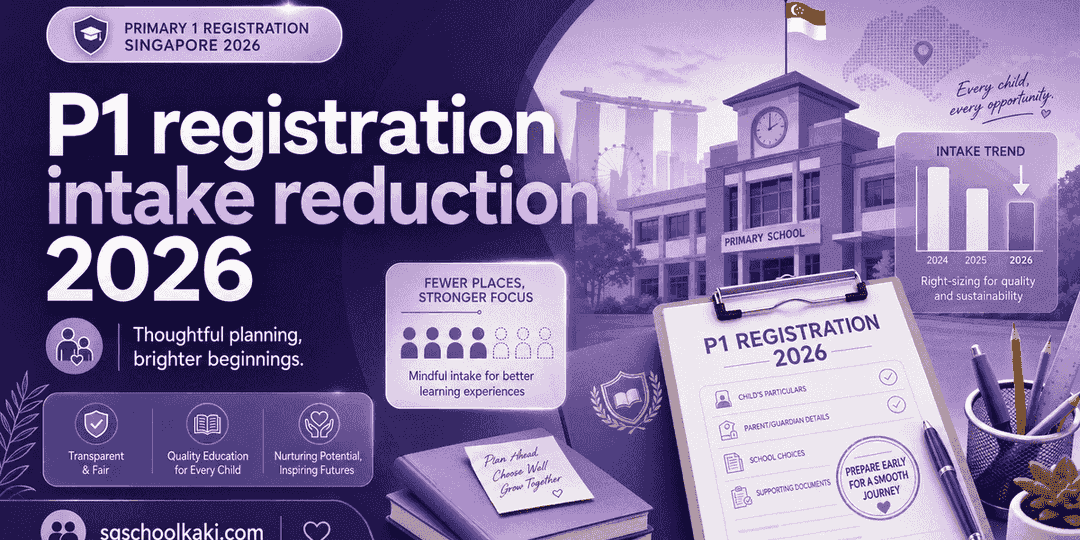
MOE has confirmed that the 2026 P1 Registration Exercise will see a gradual reduction in Primary 1 intake across most primary schools — the most significant structural change since 2022. Here is exactly what it means and what to do.
Breaking: MOE Press Release — 29 Apr 2026
MOE has confirmed the 2026 P1 Registration Exercise will see a gradual reduction in P1 intake across most primary schools. This is the most significant structural change to P1 since 2022. Official MOE press release
What MOE Announced
On 29 April 2026, MOE released its official statement on the 2026 Primary One Registration Exercise. The headline change: from this intake year onwards, MOE will begin a gradual reduction in the number of P1 places available at most primary schools.
"MOE will gradually reduce the P1 intake for the majority of primary schools over the next few years, starting from the 2026 P1 Registration Exercise."
Ministry of Education, Singapore
Press Release, 30 Apr 2026
Key Dates for 2026
Phase 2C Opens
28–30 Jul 2026
Open registration for families without priority connections
Deferment Deadline
31 May 2026
Apply for medical or other deferment by this date
Phase 3 Indication
19–25 May 2026
International students placement window
Address Declaration
29 Jun 2025 – 27 Jul 2026
Alternative address declaration window for distance priority
The Cohort Birth-Rate Story: The Data Most Coverage Has Missed
The 2026 P1 intake reduction does not happen in isolation. The 2026 P1 cohort is drawn from children born in 2020 — Singapore's COVID year — and that cohort is itself smaller than the year before.
SingStat data shows live births trending down for years. The 2026 cohort (born 2020) is ~1.8% smaller than the 2025 cohort (born 2019): 38,590 vs 39,279 births. On the surface that sounds like good news — fewer children competing for places. But the intake reduction changes that picture significantly.
Singapore Live Births 2018–2024
Source: Singapore Department of Statistics (SingStat), Vital Statistics on Live Births
Singapore Live Births 2018–2024
Smaller cohorts mean fewer P1 places needed — explaining MOE's 2026 intake reduction.
Source: Singapore Department of Statistics (SingStat), Vital Statistics on Live Births. 2024 figure provisional.
The Critical Insight: Competition Will Not Simply Ease
You might assume a smaller birth cohort means more places for everyone — but that is not how this plays out in 2026. The intake reduction is concentrated at popular schools, while the birth-rate decline is distributed across every school. The result: pressure at top-choice schools holds steady or tightens, even as overall numbers fall.
- ▲Popular / oversubscribed schools: steeper intake cuts + already scarce Phase 2C places = competition will tighten despite a smaller cohort.
- ▼Smaller or less popular schools: proportionally less reduction + smaller cohort = competition may ease modestly.
This is the original-data moat: most coverage hasn't connected these two stories. 2026 is not simply "fewer kids, more places."
Which Schools Are Hit Hardest
MOE's announcement covers "most primary schools" but the reduction is unlikely to be uniform. Logic and past policy patterns point to popular, oversubscribed schools receiving the largest absolute cuts — that is where the structural change is most needed.
Our existing data on oversubscribed primary schools in Singapore (2025) shows that these schools were already seeing Phase 2C ballot ratios well above 2:1 in 2025. A further intake reduction in 2026 will compress the already small pool of Phase 2C vacancies at those schools further.
Per-School Figures Not Yet Published
MOE has not yet released the specific vacancy reduction per school for 2026. Expect per-school confirmations between May and July 2026, ahead of the Phase 2C window on 28 July. We will update this post as data becomes available.
Phase 2C Balloting: Tighter Odds at Popular Schools
Phase 2C is the "open" phase — anyone can register, with priority determined by citizenship and home-to-school distance. It is the last point where most families without alumni or volunteer status can influence their school placement. With reduced vacancies reaching Phase 2C at popular schools, the ballot pressure will intensify.
Within 1 km
Distance priority applies — you are in the first ballot group. At a popular school with a reduced intake, even being within 1 km does not guarantee a place. Ballot ratios at top schools could worsen from roughly 2:1 to 3:1 or higher.
1 km – 2 km
The second distance band. With fewer vacancies remaining after the 1 km ballot group, families in this band face significantly tougher odds in 2026 than in previous years. A backup school is not optional — it is essential.
For a detailed breakdown of how distance bands work in Phase 2C, see our home-school distance deep dive.
PR Families Face the Steepest Impact
Permanent Resident children face an additional constraint in Phase 2C: MOE operates a citizenship-based cap, meaning only a set proportion of Phase 2C places can go to PRs (the exact percentage is not publicly disclosed but is reflected in MOE's annual infographics). When the overall intake shrinks, this cap compounds the reduction.
The Double Squeeze for PR Families
Smaller overall Phase 2C pool due to intake reduction across the school.
PR citizenship cap limits how many of those remaining places can go to PRs.
Result: at already-oversubscribed popular schools, effective PR places in Phase 2C could drop by 20–40% versus 2025.
Strategy for PR families: Diversify your school shortlist now. Prioritise schools within 1 km where your child still gets distance priority. Add 3–5 less-popular schools as genuine backups, not just names on a form.
A full strategy guide for PR families is coming at p1-registration-pr-families-strategy-2026.
What Parents Should Do Differently in 2026
The intake reduction makes proactive preparation more valuable than in any previous year. Here are the six actions that matter most:
- 1
Verify Your Home Address and 30-Month Residency — Now
Distance priority in Phase 2C is calculated from your registered home address. You need to have been resident at that address for at least 30 months before the Phase 2C registration date (28 Jul 2026). Check your NRIC address and any alternative address declaration window (29 Jun 2025 – 27 Jul 2026) today.
- 2
Build a Backup School List of 3–5 Less-Popular Schools Nearby
With Phase 2C balloting tightening at popular schools, a genuine backup list is not optional in 2026. Identify nearby schools with historically lower Phase 2C demand. Use our P1 registration tool to map all schools within 2 km of your home.
- 3
Start Phase 2B Volunteering by July 2025
Phase 2B priority requires a parent to have completed at least 40 hours of volunteer service at the school, starting no earlier than the July of the year before P1 registration. For 2026 registration, that means volunteering from July 2025. See our Phase 2B volunteer guide.
- 4
Model Balloting Odds at Your Top Choices
Use our P1 Registration hub to calculate distance from your home to shortlisted schools and see historical Phase 2C vacancy data. This is the fastest way to reality-check your chances at a specific school before investing time in a volunteer commitment.
- 5
Apply for Deferment (if Eligible) by 31 May 2026
If your child is eligible for deferment (e.g., for medical reasons), the deadline is 31 May 2026. Deferring to 2027 means your child enters the 2027 cohort (born 2021), which is similar in size to 2020 — but intake cuts may be steeper by then as MOE continues the gradual reduction. Factor this into your decision.
- 6
Watch for MOE's Per-School Vacancy Publication: May–July 2026
MOE will publish per-school vacancy figures in the lead-up to Phase 2C. This is when you will know exactly how many places are available at your target school. Bookmark the MOE Vacancies & Balloting page and check back in June 2026.
Historical Context: Singapore's Birth-Rate Decline 2018–2024
The intake reduction does not come out of nowhere. Singapore's total fertility rate (TFR) has been below the replacement level of 2.1 for decades, and has been falling faster in recent years. In 2024, Singapore's TFR was approximately 1.0 — one of the lowest in the world. Live births have fallen from roughly 40,000 per year in 2018–2019 to approximately 33,500 by 2023–2024, a decline of about 17% in six years.
The 2026 intake year is the first year MOE is responding structurally — not just absorbing the demographic change, but actively reducing school intake to match the smaller cohort sizes coming through the system. Future cohorts will continue the same trajectory: the 2027 intake (born 2021: 38,672 births) and especially the 2028–2030 intakes (born 2022–2024: 33,541–35,605 births) will see continued and likely steeper reductions.
What this means long-term: The intake reduction pattern starting in 2026 is not a one-off policy change — it is the beginning of a multi-year structural realignment of primary school capacity to Singapore's demographic reality. Parents of children born in 2022 or later should expect progressively fewer total P1 places in their registration year, though the per-family impact depends heavily on which schools they target.
Frequently Asked Questions
Q:When does the P1 intake cap reduction take effect?
A: The reduction takes effect gradually, starting from the 2026 P1 Registration Exercise. Per-school vacancy numbers have not yet been published; expect MOE confirmations between May and July 2026, ahead of the Phase 2C window on 28 July 2026.
Q:How steep are the P1 intake cuts?
A: MOE has not yet published exact per-school figures. Popular schools that are already oversubscribed are expected to see larger absolute reductions, as that is where the policy effect is most needed. Smaller schools are likely less affected.
Q:Will all primary schools have fewer P1 places?
A: MOE's announcement covers "the majority of primary schools." Some smaller or less popular schools may be less affected by the reduction. Total system-wide capacity is being right-sized to match Singapore's declining birth cohorts.
Q:What happens to my Phase 2C odds at a popular school?
A: With fewer vacancies at popular schools reaching Phase 2C, ballot pressure intensifies — especially in the 1–2 km distance band. Parents should build a genuine backup list of 3–5 less-popular nearby schools and use our P1 tool to model distance and historical vacancy data.
Q:How does the intake reduction affect PR families specifically?
A: PR families are subject to a citizenship-based cap within Phase 2C. A smaller overall intake combined with that cap means significantly fewer effective PR places at popular schools. PR families should diversify their school choices and prioritise schools where distance priority (within 1 km) still applies.
Plan Your Child's P1 Strategy
Use our P1 Registration hub to calculate your home-to-school distance using official OneMap data, explore historical vacancy and ballot data for all primary schools, and model your child's Phase 2C odds before committing to a school.
⭐ Original SGSchoolKaki Data
See exactly which 61 schools had places cut — all 179 schools listed
We cross-referenced our 2025 baseline with MOE's live 2026 vacancies page and built a sortable per-school comparison table — see exactly which schools were cut and by how much, side-by-side. Top cut: Clementi Primary −80 places (−25%).
View Full 2025 vs 2026 ComparisonSources & Citations
- MOE Press Release: 2026 Primary One Registration Exercise (30 Apr 2026)
- MOE: P1 Registration Phases and Eligibility
- Singapore Department of Statistics: Vital Statistics on Live Births
- SGSchoolKaki: P1 Registration Hub (distance calculator + vacancy data)
- SGSchoolKaki: Oversubscribed Primary Schools Singapore 2025
- SGSchoolKaki: Home-School Distance 1 km vs 2 km Deep Dive
Keep learning with SGSchoolKaki
Ask KlickAI, our AI tutor
Stuck on a concept? Get a step-by-step explanation aligned to the Singapore syllabus. Free to start.
Try KlickAI
Practise real exam-style questions
Past-paper style questions with worked solutions, so students learn from every answer. Free practice available.
Open the Question Bank
Written by
SGSchoolKaki Education Team
Our team of ex-MOE teachers, private tutors and education data analysts brings 16+ years of combined experience.