
Singapore's Universities, Polytechnics and ITE
Will Teach AI Skills by 2027
AI competencies will be built into compulsory modules across all institutes of higher learning — here is what it means for students and parents.
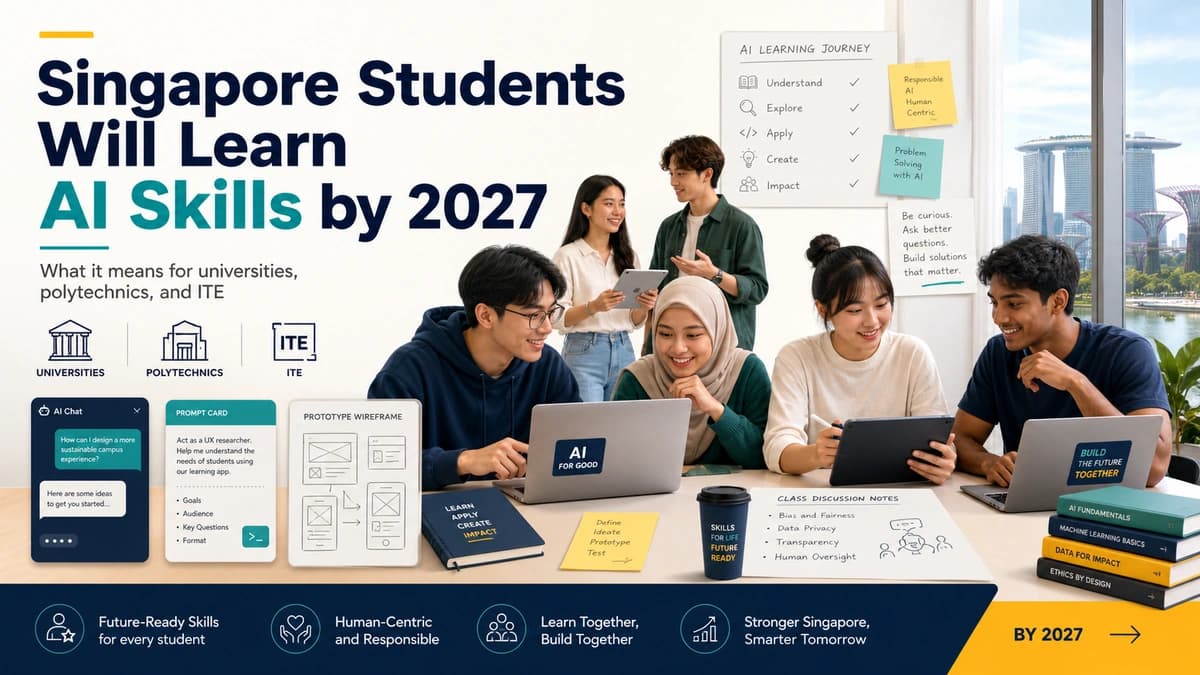
Singapore is making a pretty big move: by 2027, all university, polytechnic and ITE students will get AI skills as part of their studies. This is not just some extra workshop or optional seminar. It will be built into compulsory modules[2], which means AI is about to become a normal part of higher education here.
At first glance, this sounds like another “future-ready” announcement. But if you look deeper, it is actually quite a significant shift. Singapore is not just saying students should know how to use AI — it is saying every student should understand how to use it properly, think with it, and still keep their own judgement intact.
What every student and parent should know
| Point | What it means |
|---|---|
| AI skills for all IHL students by 2027 | Every student in university, polytechnic and ITE will get AI training as part of compulsory learning. |
| Discipline-specific AI competencies | Different institutions will teach AI in ways that match their courses and students' needs. |
| AI is not meant to replace thinking | Students still need to learn fundamentals, question outputs, and use judgement. |
| Critical thinking stays important | AI should deepen understanding, not become a shortcut that replaces real learning. |
| Practical use in class | Students may use AI tools for brainstorming, prototyping, problem-solving and reflection. |
| Responsible use matters | Ethical, social and legal implications of AI will also be part of the learning. |
What the new plan is about
The main idea is simple: every student in an institute of higher learning, whether they are in a university, polytechnic, or ITE, will get a foundation in AI competencies by AY2027[2]. These skills will not be taught as a random add-on. They will be infused into compulsory modules so that students learn AI in a way that is relevant to their own field.
That is an important distinction. A design student, an engineering student, a business student, and an ITE student will not all use AI in the exact same way. The goal is not to make everyone into AI engineers. The goal is to make students competent in using AI inside their own discipline.
Education Minister Desmond Lee put it well when he said what matters is the mastery to combine AI with deep disciplinary knowledge meaningfully[1]. In other words, AI should help students go further, not just faster.
Why this matters for students
This is a very practical move because AI is already being used everywhere. Students are using it to write, summarise, brainstorm, code, design, and revise. The real question is not whether students will use AI — they already are. The real question is whether they know how to use it well.
And that is where Singapore seems to be taking a sensible approach. Instead of pretending AI can be kept out of the classroom, the education system is accepting reality and building structure around it. That is a much better move than just banning tools and hoping for the best.
For students, this could be a big advantage. Learning AI properly early means they can enter the workforce with a stronger edge. They will not just know how to prompt a chatbot. They will understand how to check outputs, refine them, and use them in meaningful ways.
Why this approach feels right
One thing that stands out from the announcement is that the government is not treating AI as a replacement for learning. That is important, because it is very easy for people to think AI means “less effort needed.” But the message here is the opposite.
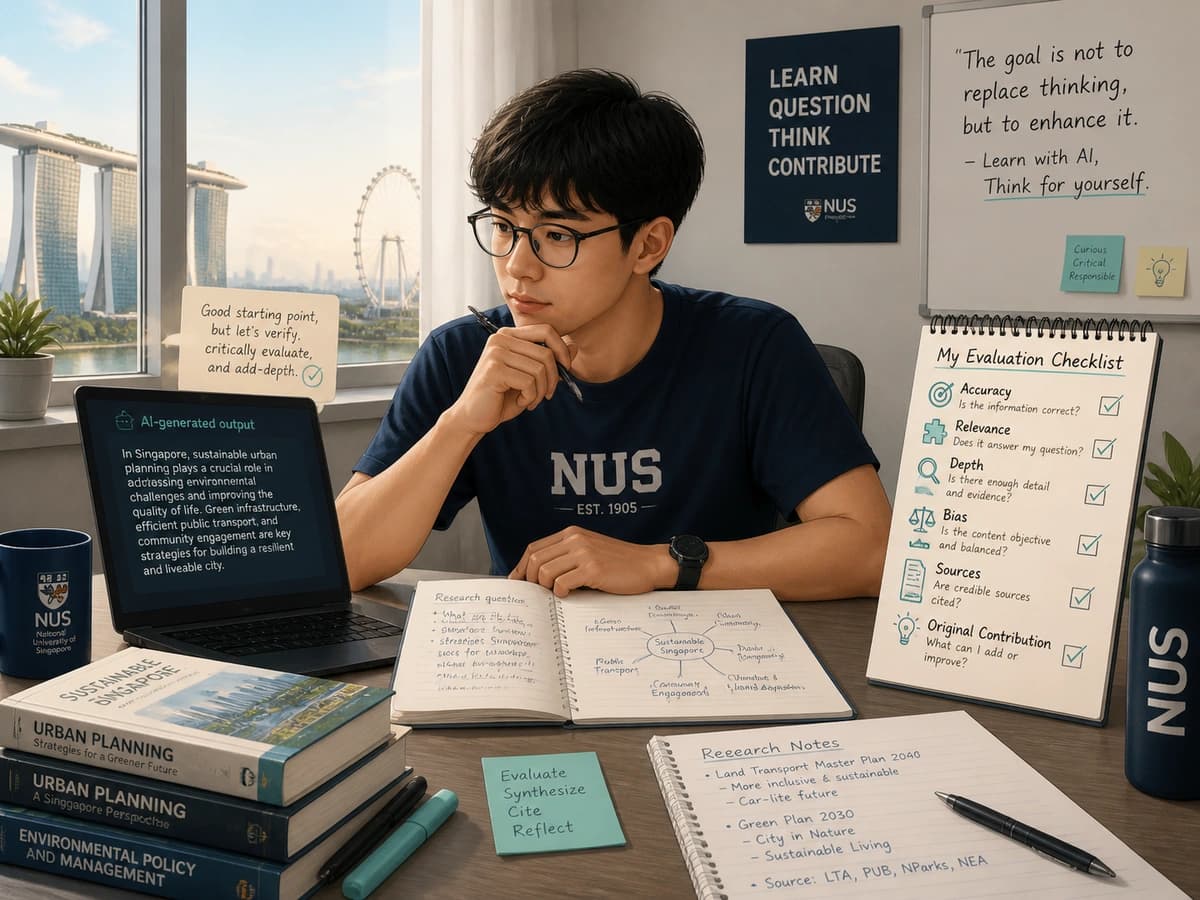
Students still need to build deep knowledge. They still need to think, write, analyse, design and solve. AI is there to support those skills, not erase them. That is why the minister emphasised that students must still experience the struggle of learning — researching, questioning, testing ideas and grappling with difficult concepts[1].
That part is actually quite reassuring. It means Singapore is not going all-in on shortcuts. It is trying to prepare students for a world where AI is everywhere, while still keeping human judgement at the centre.
→ For parents of younger kids — what's happening before university…
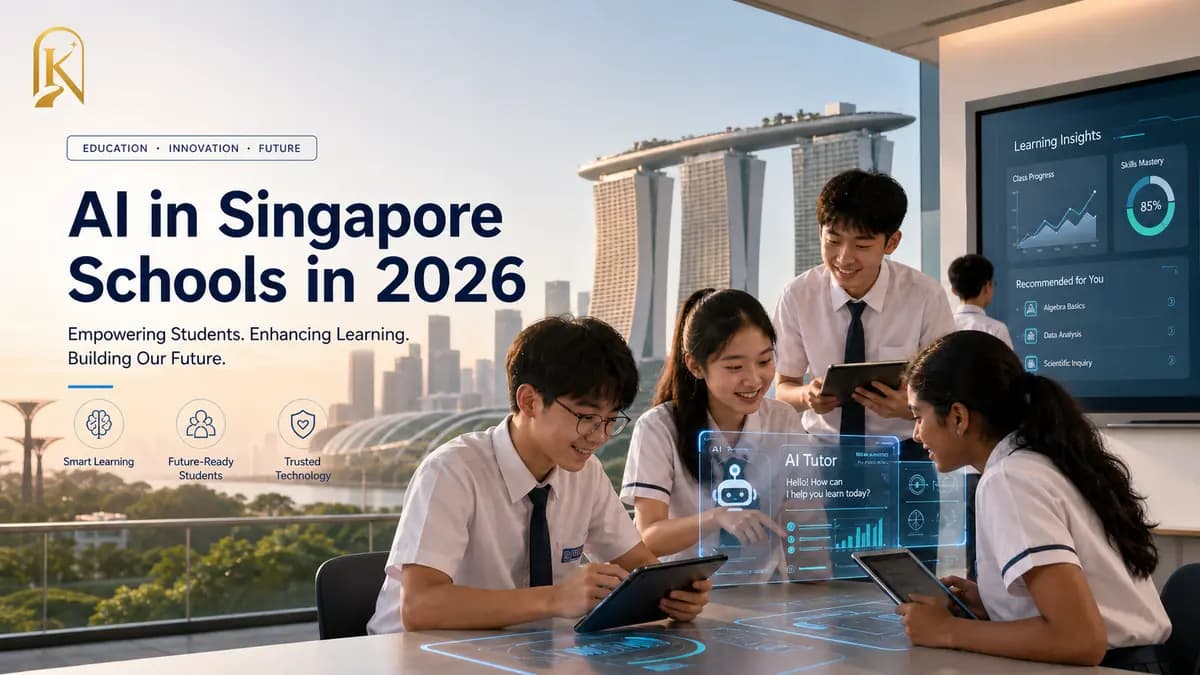
AI in Singapore Schools: How MOE Is Using AI for Students in 2026
MOE's age-tiered AI rollout via the Student Learning Space — LEA, ALS, and what every SG parent should know before secondary.
What schools are already doing
Even before the 2027 mandate, Singapore's IHLs are already building AI into teaching in different ways[3].
Industry-style AI workflow
NUS PDI students use AI tools the way the industry does — to sharpen problem statements, brainstorm ideas, and prototype faster. AI is not just theory anymore; it is becoming part of the actual workflow.
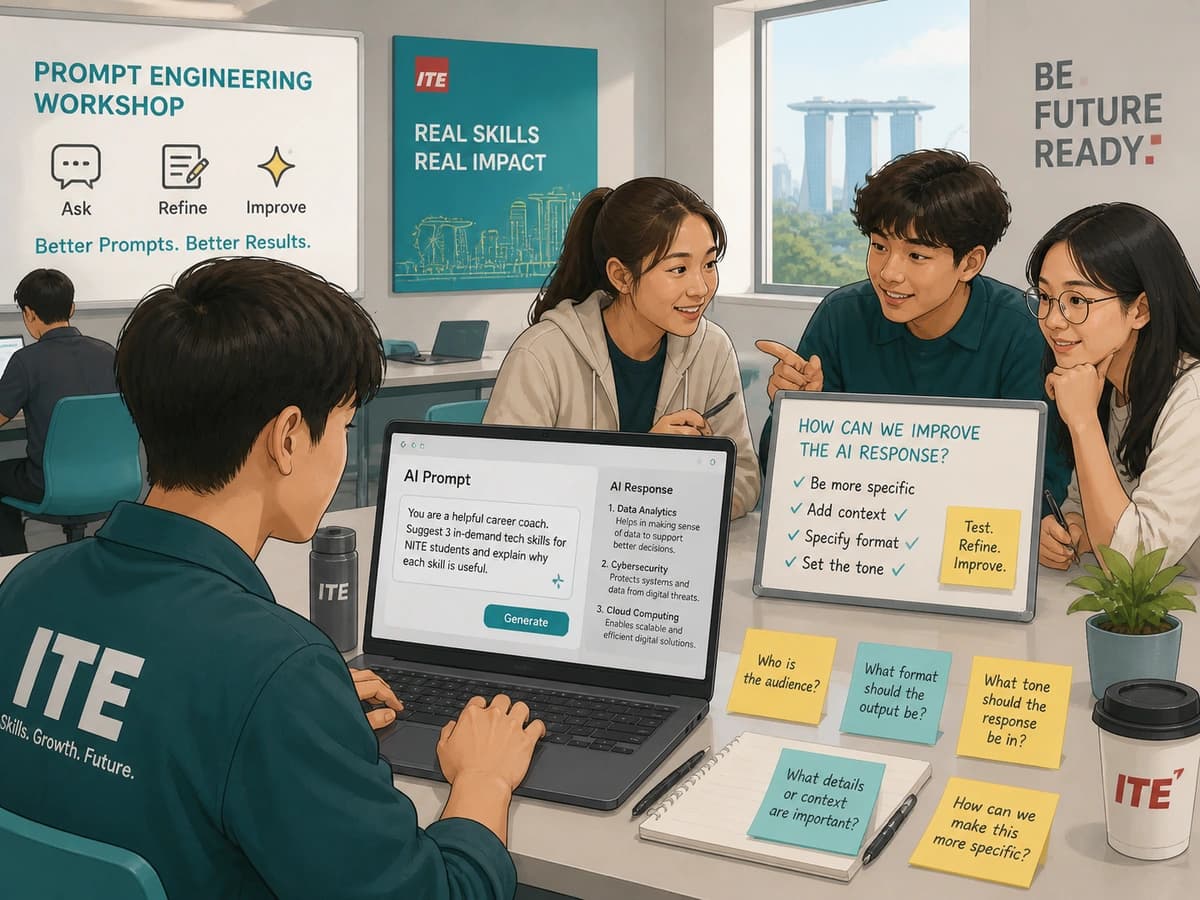
Prompt engineering for all
ITE introduces prompt engineering for all first-year students. Knowing how to ask the right question is often more important than just having access to the tool.
AI across undergrad courses
NTU integrates AI across a large share of its undergraduate courses while making sure students still learn about responsible use. Innovation and discipline, in balance.
→ Want a real-world example? NTU just made this concrete…
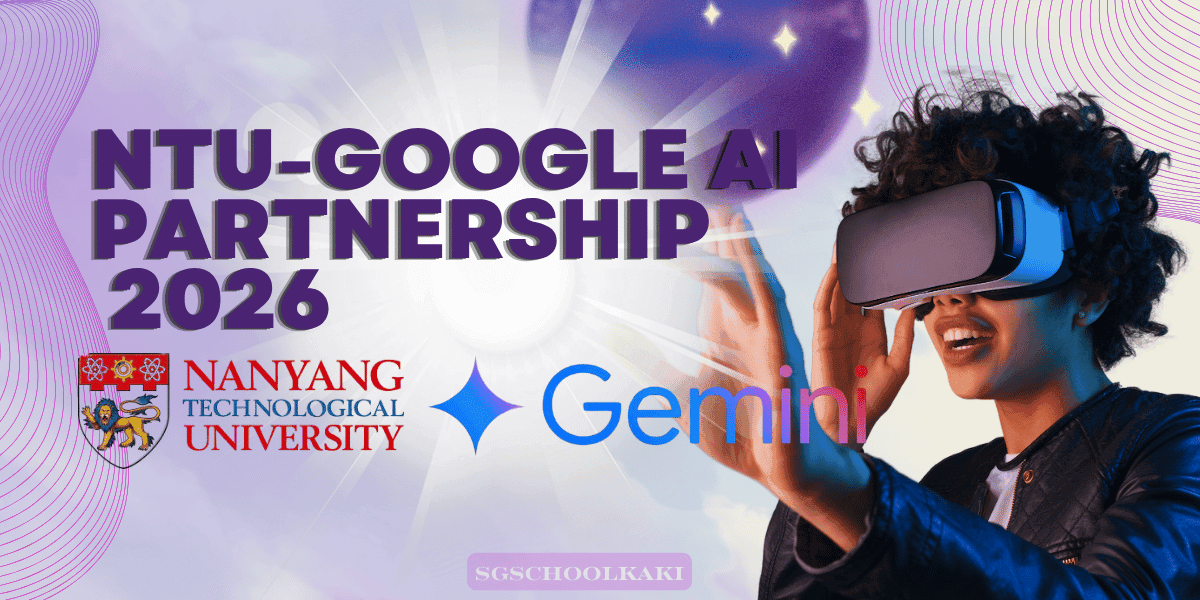
NTU-Google AI Partnership: Free AI Tools Worth $720+ Per Student
NTU is the first Singapore university giving all undergraduates free Google AI tools — Gemini Enterprise, Vertex AI, computing credits. The full value breakdown.
Our take at SGSchoolKaki
We think this is a strong move, and honestly, Singapore is in a very good position here. As AI advances, SG is quite well prepared, and with the government spearheading this direction, it can make our students among the most competitive in the region — and maybe even across Asia.
Of course, the key is execution. If the curriculum becomes too shallow, then it will just be another checkbox exercise. But if it is taught in a serious, hands-on way, then students will genuinely benefit.
The bigger picture
This announcement also shows something else: AI is no longer being treated as a niche tech topic. It is becoming part of general education, just like writing, research and communication. That is a big mindset shift.
In a few years, employers may not just ask whether a graduate knows Excel or PowerPoint. They may expect graduates to know how to work with AI tools, check for hallucinations, use them responsibly, and apply them in real situations. Students who learn this early will definitely have a head start.
→ The job-market reality students are walking into…

Will AI Steal Your Dream Job? What Singapore Students Must Know in 2026
Amazon, Meta and Intel cut 157,000+ jobs as AI advances. What Singapore A-Level students must know before choosing a university course.
At the same time, there is a caution here. Students should not become overly dependent on AI. If they let the tool do all the thinking, they may lose the very skills that make them valuable in the first place. So the real advantage will go to those who know how to use AI smartly without becoming lazy with it.
for SG students & parents
AI should amplify learning
Overall, this is a positive and timely move for Singapore's education system. It recognises that AI is here to stay, and it prepares students to use it well rather than fear it — and if done with discipline and clarity, our students could be very competitive not just locally, but regionally as well.
AI can help you learn faster, work smarter, and become more capable in your own field — IF you keep the fundamentals strong and your judgement sharp.
Don't let your child use AI as a shortcut. The advantage goes to students who use AI smartly without becoming lazy with it.
SGSchoolKaki tools that work alongside your studies
Most of what we build is free: daily practice, flashcards, MOE-aligned grade calculators, exam timetables and the official MOE calendar. KlickAI is our paid AI tutor — one of the lowest-priced in the market — for families that want unlimited, syllabus-aware tutoring at home.
Question Bank
Free daily practice for PSLE, O-Level and A-Level — every student gets free questions every day.
Flashcards
Quick-recall decks for vocab, formulas and key concepts — built for spaced repetition. Always free.
KlickAI — AI Tutor
Asks guiding questions, never just hands over the answer — same spirit as Singapore's IHL AI vision. Singapore syllabus, one of the lowest prices in the market.
Grade Calculators
PSLE AL · O-Level L1R5/L1R4 · A-Level rank points — MOE-aligned, with school-matching by score.
Exam Schedules
Full national exam timetables — paper-by-paper view with countdown.
See all schedulesMOE School Calendar
Official MOE term dates, holidays and key milestones for the whole school year — one tidy view.
Related reading
AI in Singapore Schools: How MOE Is Using AI for Students in 2026
MOE's age-tiered AI rollout via the Student Learning Space — LEA, ALS, and what parents need to know.
AI Jobs & Future Careers for Singapore Students
Where AI is creating new roles in Singapore, and what students should study to land them.
Sources & Further Reading
Singapore — Primary Sources
SGSchoolKaki Education Team
Ex-MOE Teachers, Private Tutors & Education Data Analysts with 15+ Years Combined Experience
Reviewed by: KW Phoon
Founder, BEng(Hons) in Computing Engineering
Data-Driven Education Platform