
AI in Singapore Schools:
How MOE Is Using AI for Students in 2026
MOE is already using AI through the Student Learning Space — but under strict age-tiered rules. Here is what is actually happening, and what it means for parents.
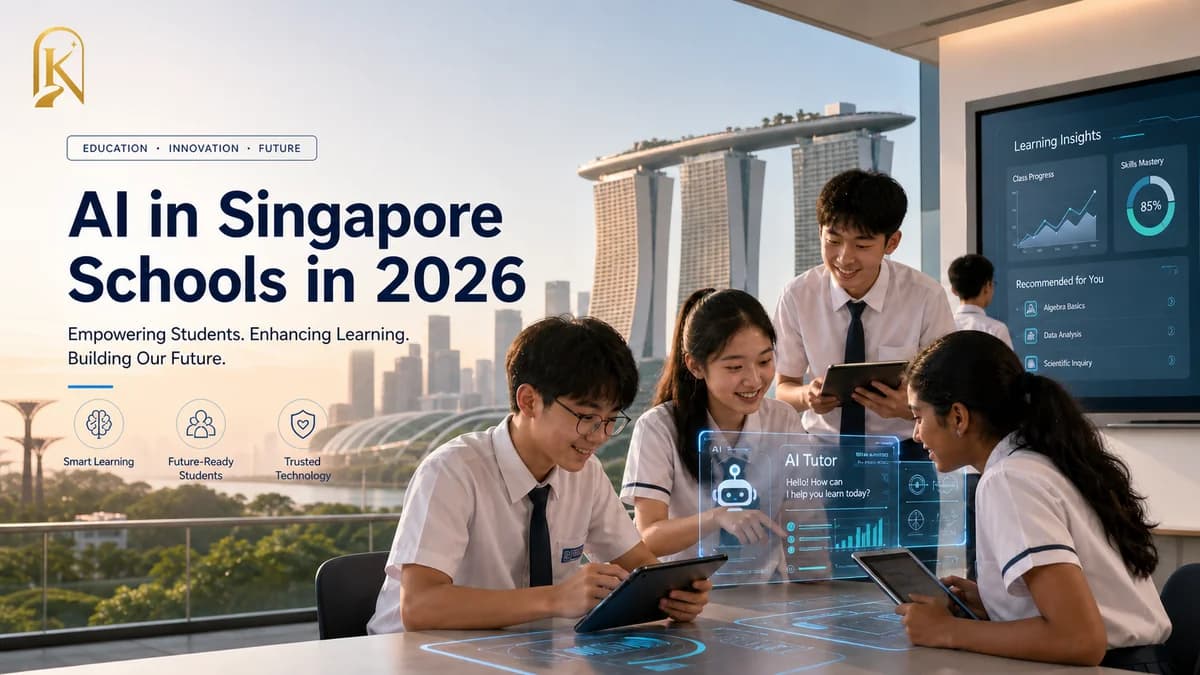
Artificial intelligence is no longer a future trend in Singapore classrooms. MOE is already using AI through the Singapore Student Learning Space (SLS)[1]— the same national platform every Singapore school student logs into — to help students learn more deeply and to give teachers tools for personalised feedback.
The reason this matters is that Singapore is not rolling out AI as a free-for-all. MOE's approach is structured, age-appropriate, and built around four principles — agency, inclusivity, fairness, and safety[4]— which makes it very different from letting children loose on public chatbots.
The five things every SG parent should know
- 1.MOE's AI tools live inside SLS, not in public chatbots. The two flagship features are Learning Assistant (LEA) and the Adaptive Learning System (ALS)[1].
- 2.Lower-primary pupils do not directly use AI. From Primary 4, AI use is structured, limited, in class and under close teacher supervision[3].
- 3.ALS currently personalises practice in Mathematics (Upper Primary & Lower Secondary) and Geography (Upper Secondary)[2].
- 4.MOE's framing for students is “learn about AI, learn to use AI, learn with AI and learn beyond AI”[1]— not just generate answers faster.
- 5.Every secondary school student has a school-prescribed Personal Learning Device under the National Digital Literacy Programme; for families on financial assistance, the cash out-of-pocket can be S$0[6].
What AI is MOE actually using in schools?
MOE's AI tools are delivered through SLS, Singapore's national online learning platform — not through unrestricted consumer apps. There are two flagship AI features, with more in the pipeline.
LEA — the question-asker
LEA “helps students learn by asking guiding questions. It takes on different roles to encourage students to think in different ways, making learning more engaging and interactive.”[1]Think of it as a Socratic tutor — it prompts reflection rather than handing over answers.
ALS — the personaliser
ALS “creates a personalised learning path for each student by giving them custom recommendations and feedback based on their readiness.”[1] It is currently available for Mathematics (Upper Primary & Lower Secondary) and Geography (Upper Secondary)[2], with more subjects to follow.
Beyond LEA and ALS
MOE also highlights AI-enabled feedback and speech tools inside SLS — all governed by the MOE AI Ethics Framework's four principles: agency, inclusivity, fairness, and safety[4].
How students are allowed to use AI — by age
The most important signal from MOE is that AI use in schools is not the same for every age group. In an April 2026 forum reply, MOE laid out the tiers explicitly[3].
P1 — P3
“Learning is print-first, with an emphasis on concrete and tactile experiences. Pupils do not directly use AI.”[3]
P4 — P6
“AI use is structured and limited, in class and under close teacher supervision.” The tools are MOE-developed, not general-purpose chatbots[3].
S1 — JC
Students get progressively wider exposure inside SLS, including LEA and ALS for relevant subjects, alongside digital-literacy and responsible-AI lessons[1].
MOE's framing is broader than “use AI to get answers faster.” The official goal is that students “learn about AI, learn to use AI, learn with AI and learn beyond AI”[1]— meaning AI literacy, productive use, collaboration, and critical judgement about its limits.
What this actually means for parents
The big takeaway is that Singapore schools are trying to keep AI useful without lazy. MOE's school-based tools come with built-in safety guardrails, and SLS publishes guidance for parents on responsible generative-AI use at home[4].
Many families worry that AI will make children dependent on shortcuts. Singapore's current model points the other way: AI to prompt reflection, improve feedback, and personalise practice — while keeping teachers in charge and students mentally engaged.
The better question for SG parents is no longer “Should my child use AI at all?” It is:
“How do I help my child use AI well — safely, and without losing the habit of thinking for themselves?”
How much does Singapore spend per student?
There is no separate publicly listed “AI subsidy per student” line item. The most accurate proxy is the government's recurrent operating expenditure per student, which funds the whole public system — including SLS, devices, teachers, and AI rollout[5].
Source: SingStat Table M850291 (FY2025 recurrent government expenditure on education per student)[5]. Not all of this is spent on AI — but it indicates the scale of the system that AI is being deployed inside.
Direct device support: National Digital Literacy Programme
Every secondary school student in Singapore now has a school-prescribed Personal Learning Device (PLD) under the NDLP — the device families use to access SLS and its AI features.
- Edusave funds can be used to pay for the PLD bundle[6].
- Lower-income Singapore Citizen students receive a subsidy of 50% of the device bundle cost or up to S$350— whichever is lower[6].
- For students on the MOE Financial Assistance Scheme, MOE may provide additional subsidy so that cash out-of-pocket can be S$0[6].
Singapore vs Korea, Japan & Australia
We read the press releases and the national policy texts from four jurisdictions. Here is where Singapore actually lands.
Singapore highlighted — this post
| Country | School AI approach | Compared with Singapore |
|---|---|---|
SingaporeThis post | MOE delivers AI through SLS— primarily LEA (question-asking) and ALS (personalised practice). Age-tiered: no direct AI use in lower primary[3]. | More centralised and platform-based; school use is tied to MOE-built tools rather than open consumer AI. |
South Korea | Launched AI digital textbooks in March 2025for math, English and computer science in selected grades — but by August 2025Korea's National Assembly stripped their official textbook status and re-classified them as “supplementary material”; adoption fell from 37% to 19%[7][8]. | More aggressive at the textbook layer, but the pushback was rapid. Singapore looks more cautious and platform-based. |
Japan | Cabinet adopted Japan's first AI Basic Plan in December 2025; the plan emphasises “Trustworthy AI” and balances innovation with risk management[9]. | More strategy-level than classroom-level — Singapore is further along describing concrete school-level tools and their guardrails. |
Australia | The Australian Framework for Generative AI in Schools (Education Ministers, Oct 2023; reviewed 2024) guides “the responsible and ethical use of generative AI tools”[10]. | Framework-led nationally; states implement school-side rules. Singapore combines national framework plus MOE-operated classroom tools. |
Singapore row highlighted. All claims linked to primary-source citations in the Sources section below.
Why this matters
for SG parents & students
The real story is not just that Singapore schools are using AI. It is that Singapore is trying to make AI a supervised learning support system rather than an answer machine— which could become one of the country's biggest education advantages if done well.
AI will keep showing up in school life — especially for guided practice, feedback and personalised learning.
The conversation at home is the important half: model the curiosity, model the scepticism, and keep asking the right question.
SGSchoolKaki tools that work alongside SLS
Most of what we build is free: daily practice, flashcards, MOE-aligned grade calculators, exam timetables and the official MOE calendar. KlickAI is our paid AI tutor — one of the lowest-priced in the market — for families that want unlimited, syllabus-aware tutoring at home.
Question Bank
Free daily practice for PSLE, O-Level and A-Level — every student gets free questions every day.
Flashcards
Quick-recall decks for vocab, formulas and key concepts — built for spaced repetition. Always free.
KlickAI — AI Tutor
Asks guiding questions, never just hands over the answer — same spirit as MOE's LEA. Singapore syllabus, one of the lowest prices in the market.
Grade Calculators
PSLE AL · O-Level L1R5/L1R4 · A-Level rank points — MOE-aligned, with school-matching by score.
Exam Schedules
Full national exam timetables — paper-by-paper view with countdown.
See all schedulesMOE School Calendar
Official MOE term dates, holidays and key milestones for the whole school year — one tidy view.
Related reading
Sources & Further Reading
Singapore — Primary Sources
- [1]MOE: Artificial Intelligence in Education (EdTech Masterplan)
- [2]SLS: Adaptive Learning System (ALS) — subject coverage
- [3]MOE forum reply (Apr 2026): Schools introduce AI in an age- and development-appropriate approach
- [4]SLS: AI in Education Ethics Framework (Agency, Inclusivity, Fairness, Safety)
- [5]SingStat Table M850291 — Recurrent Government Expenditure On Education Per Student
- [6]MOE press release: Blended Learning & National Digital Literacy Programme (PLD subsidies)
International
- [7]Rest of World: South Korea's AI textbook rollout and pushback (2025)
- [8]Korea Herald: AI digital textbook subjects and grade coverage
- [9]Japan Cabinet Office: AI Basic Plan (English, Jan 2026 provisional translation)
- [10]Australian Government: Framework for Generative AI in Schools
- [11]GovTech (Apr 2026): Inside Singapore's digital classroom — how AI is supporting teachers and students
SGSchoolKaki Education Team
Ex-MOE Teachers, Private Tutors & Education Data Analysts with 15+ Years Combined Experience
Reviewed by: KW Phoon
Founder, BEng(Hons) in Computing Engineering
Data-Driven Education Platform